|
HISTORY.
| Settled at |
Mobile Bay |
| Settled in |
1702 |
| Founded by |
Frenchmen |
| Admitted to the U. S. |
1819 |
| Population in 1860 |
964,201 |
| In 1870 |
996,992 |
| In 1880 |
1,262,505 |
| In 1890 (U. S.
Census) |
1,513,017 |
|
White |
830,796 |
|
Colored |
681,431 |
| Voting Population |
259,884 |
| Vote for Harrison
(1888) |
57,197 |
| Vote for Cleveland
(1888) |
117,320 |
| Net Public Debt |
$11,992,619 |
| Area (square miles) |
52,250 |
| U. S. Representatives (1893) |
9 |
| Militia (Disciplined) |
2,954 |
| Counties |
67 |
| Post-offices |
2,028 |
| Railroads (miles) |
3,422 |
| Manufacturers (yearly in 1880) |
$13,566,000 |
| Operatives |
10,019 |
| Yearly Wages |
$2,500,000 |
| Farm Land (in acres) |
18,855,000 |
| Farm-Land Values |
$79,000,000 |
| Farm Products
(yearly) |
$57,000,000 |
| School Children, enrolled |
259,432 |
| Newspapers |
180 |
| Latitude |
30°
13´ to 35° N |
| Longitude |
7°
51´ to 10°
38´ W |
| Temperature |
5°
to 107° |
| Mean Temperature (Mobile) |
66° |
|
TEN CHIEF CITIES AND THEIR
POPULATIONS (Census of 1890) |
| Mobile |
31,076 |
| Birmingham |
26,178 |
| Montgomery |
21,883 |
| Anniston |
9,998 |
| Huntsville |
7,995 |
| Selma |
7,622 |
| Florence |
6,012 |
| Bessemer |
4,544 |
| Eufaula |
4,394 |
| Tuskaloosa |
4,215 |

BIENVILLE
At the dawn of her history, Alabama contained four
tribes of aborigines, the civilized and hospital Cherokees,
in the northeast, in a region that they always called Chiah;
the warlike and heroic Chickasaws, in the northwest, along
the Tennessee, the Tombigbee and the Upper Yazoo; the
friendly Choctaws, in the west and southwest; and the
Muscogees (or Creeks), called by Bancroft "the most
powerful nation north of the Gulf of Mexico," west of the
Ocmulgee.
The first historical mention of Alabama deals with the
marches of Hernando De Soto, the Spanish cavalier, with 620
knights and priests, crossbowmen and arquebusiers of Spain,
who landed at Tampa Bay, cross Georgia, and Spain, who
landed at Tampa Bay, crossed Georgia, and entered Alabama in
July, 1540 (80 years before the Pilgrims arrived at
Plymouth). The army visited Coosa, Tallasee, and other
Indian towns, in search of a land of gold; and then marched
by Piachee to Maubila (whence comes the name of Mobile.
Here they were fiercely attacked, and during a long day's
battle in and around the burning town, the Spaniards
defeated the natives, losing 168 men, and slaying 2,500.
Thence the European army moved through the lonely land of
Pafallaya, and up the Tombigee Valley into Mississippi,
fighting many a bloody battle, and enduring and causing
frightful sufferings. One hundred and sixty-two years
later, the sieur do Bienville, "the Father of Alabama,"
transferred his French colony from Biloxi to Dog River, on
Mobile Bay, and erected Fort St. Louis de la Mobile.
In 1711, he moved to the present site of Mobile. A few
years later, English traders from Georgia built a stockade
at Ocfuskee; and Gen. Ogiethorp made a treaty with
the Muscogees, at Coweta. After the cession of the
trans-Alleghany country to Great Britain, at the peace of
1763, the part of Alabama south of Selma and Montgomery was
included in the district of West Florida, and the unsettled
country to the
[Page 28]
north belonged to the district of Illinois.
Montgomery lay in Florida, and Wetumpka in Illinois.
The people here were so few, and so remote from the Atlantic
settlements, that they did not unite with the Thirteen
Colonies in their conflict with England. Envoys and
agitators sent from the United States were seized and
imprisoned in the stone keep of Fort Charlotte. When
Spain Declared war against the mother-country, Galvez,
the governor of Louisiana, with 2,000 soldiers, besieged and
captured Mobile, even then a French town,
The Spaniards held the country until 1798, as a part of
Florida. Georgia also claimed nearly all of Alabama
and Mississippi, under her royal charter of 1665, and in
1798 and 1802 ceded them to the United States for
$1,250,000.

MONTGOMERY: SOLDIERS'
MONUMENT
About 1790, American pioneers
began to settle in the northern valleys. In 1798,
Congress formed Mississippi and Alabama, from 31°
to 32° 28´, and between the Mississippi River and the
Chattahoochee, into the Mississippi Territory; and four
years later, the Territorial boundary was carried north to
the Tennessee line. The Indians ceded vast domains to
the incoming Americans by the treaties of 1805; but
Tecumseh aroused the Creeks to war, and in 1813 they
destroyed Fort Mimms, with its 500 inmates. Gen.
Coffee retaliated by killing 186 Indians in battle at
Tallaseehatchee; Andrew Jackson won the fight at
Talladega; Gen. White destroyed Hillabee; and after
many other engagements, Jackson slew 600 creeks at
the Horse-Shoe Bend, losing 210 men himself. In the 30
engagements of the Creek war 4,000 Indians were killed.
The Spanish power at Mobile was broken by Gen.
Wilkinson's army from New Orleans, in 1813; and a
British attack on Fort Bowyer, at Mobile Point, met a
disastrous repulse, followed by Jackson's capture of
Pensacola. In 1817, Congress organized the Territory
of Alabama, with its present boundaries, and St. Stephens as
the capital.. Two years later, Alabama became a State
, then having about 127,000 inhabitants, besides the
Indians. Cahaba became the capital in 1820; Tuskaloosa,
in 1826; and Montgomery in 1847. After frequent Indian
wars, mainly with the Creeks, the tribes were removed to the
Indian Territory, the Choctaws in 1830, the Chickasaws in
1834, the Cherokees in 1836, and the Creeks in 1837.
The population in 1860 included 526,271 whites,
435,080 negro slaves (owned by 30,000 persons) and 2,690
free negroes. Alabama was then the fifth State in the
value of its agricultural products, and the seventh in
wealth. Its valuation sunk from $792,000,000 in 1860
to $202,000,000 in 1865 (partly due to the emancipation of
the slaves).

MUSCLE SHOALS AND
CANALS
Late in 1860 the National forts at Mobile were occupied
by Alabama troops; and in January, 1861, by a vote of 61 to
39, the State suceded from the Union. In the mournful
conflict which followed, she sent into the field 122,000
soldiers (in 69 regiments of infantry, 12 of cavalry, and 27
batteries), one fourth of whom died in the Confederate
service. The northern counties long remained devoted
to the Republic, and desired to erect themselves into a new
State. The chief local events were Forrest's
capture of Streight's 1,700 Union cavalry, in
Cherokee County; Rousseau's raid through the southern
counties; and Farragut's attack on Mobile, resulting
in the capture of Forts Morgan and Gaines, and followed by
the reduction of Spanish Fort, the storming of Blakely, and
the occupation of Mobile (in April, 1865), by Gen. Canby's
Union army of 45,000 men after much fighting. At the
same time, Gen. Wilson, with 9,000 mounted troops
from the north, stormed Selma, destroying the Arsenal and
Navy Yard, and occupied Montgomery. Several thousand
white Alabamians served bravely in the National armies.
[Page 29]

THE ALABAMA RIVER.
The re-establishment of the National power was
followed by unhappy years of carpet-bag administration, when
the treasury of the State suffered from venal
legislation, and her standard eight per cent. bonds fell to
20 cents on the dollar. Emerging at last from this
cloud, Alabama has resumed her place as one of the most
conservative of the Southern States, with a strong and
capable "white man's government." Within ten yeas a
wonderful and unexampled development of mineral wealth has
gone forward, is the northern part of the State, which is
already entering into competition with Pennsylvania as a
producer of coal and iron. The output of pig-iron
alone, mounted from 449,492 tons in 1888 to 791,425 in 1889,
and is still increasing, and building up new cities.
The Name of Alabama comes from its chief river,
and the word being of Indian origin and unknown meaning.
There is a poetic legend that an exiled Indian tribe reached
the great river, and its chief struck his spear into the
shore exclaiming, Alabama! - that is to Alabama is
sometimes called THE COTTON-PLANTATION STATE.

MOBILE: THE SHELL ROAD
The Arms of Alabama bear an eagle, with raised wings,
alighting upon the National shield, and bearing three arrows
in his left talon. He holds in his beak a floating
steamer, inscribed with the words HERE WE REST. this
nobly patriotic device was adopted in 1868, to replace the
older seal, a rude outline map of Alabama, fastened to a
tree.
The Governors of Alabama have been William Wyatt Bibb,
1817-20; Thomas Bibb, 1820-21; Israel Pickens,
1821-25; John Murphy, 1825-9; Samuel B. Moore,
1829-31; John Gayle, 1831-5; Clement Comer Clay,
1835-7; Hugh McVay, 1837; Arthur Pendleton Bagby,
1837-41; Benjamin Fitzpatrick, 1841-5; Reuben
Chapman, 1847-9; Henry Watkins Collier, 1849-53;
John Anthony Winston, 1853-7; Andrew Barry Moore,
1857-61; John Gill Shorter, 1861-3; Thomas Hill
Watts, 1863-5; Lewis Eliphalet Parsons, 1865
(provisional); Robert Miller Patton, 1865-8;
William Henry Smith, 1868-70; Robert Burns Lindsay,
1870; David C. Lewis, 1872-4; George Smith Houston
1874-8; Rufus W. Cobb, 1878-82; Edward Asbury O'Neal;
Thomas Seay, 1886-90; and Thos. G. Jones, 1890-2.

MOBILE
Descriptive - Alabama is from 150 to 202 miles
wide, between Georgia and Mississippi, and from 278 to 336
miles long, between Tennessee and Florida and the Gulf of
Mexico. It is larger than New York or Pennsylvania,
Virginia or England. The northeast contains the
declining Alleghany ridges, melting away toward the south
into a broken hill-country, and then into extensive plains,
which for 60 miles inland are almost on the sea-level.
There are four great divisions of the State - the cereal,
mineral, cotton, and timber regions. The beautiful
Tennessee Valley, in the temperate and health ful north, is
a rich agricultural country, rising toward the east into the
long blue highlands of the Raccoon and Lookout ranges.
The Alabama section of the valley is 200 miles long and 20
[Page 30]
miles wide, covering eight counties, and with 180,000
inhabitants. This is the Cereal Belt, its fertile red
lands producing grains and grasses, cotton and fruits, with
noble mountain walls sheltering it alike from the icy
southern winds and the intense heats of the southern plains,
and traversed by rich lateral valleys, abounding in farms.
The Mountain and Mineral Region covers the northeast, and
the Alleghany Mountains, which open out across all
north-central Alabama, with 5,500 square miles of rich
coal-measures, and vast deposits of iron-ore and limestone.
It includes 28 counties, with 400,000 inhabitants. The

MOBILE: GOVERNMENT STREET
Agricultural Region, 70 miles wide, clear across the
State, comes next, between 33°
and 31° 40´, in the rotten limestone formation, scarce of
water, but on the west occupied by fertile bald prairie and
wooded prairie. This is the celebrated Black Belt, or
Cane-Brake Region, where the negroes greatly predominate in
numbers, raising vast quantities of cotton from the richest
of lands. It includes 17 counties, with over 500,000
inhabitants. The Piney-Woods Region extends from the
Black Belt to the Gulf, more than a hundred miles wide,
abounding in long-leafe and yellow pine, and low and
miasmatic along the rivers and coast, but elsewhere
undulating, with

MOBILE: COTTON
EXCHANGE
a sandy soil. The summers are long, but
tempered by the Gulf breezes, and vary between 73°
and 94°. Here grow the magnolia and the sweet-bay,
gigantic water-oaks and live-oaks, black gums and venerable
cypresses. Turpentine and rosin are valued products;
and vast quantities of lumber are shipped thence. The
land is very cheap; and the exporting of naval stores is
facilitated by the navigable bays and entrances along the
coast.
The Gulf coast of Alabama, only 50 miles long, is
broken by Mobile Bay, entering the land for 30 miles, and
navigable by an artificial channel for vessels drawing 19
feet of water. The deep and broad Mobile River, 50
miles long, enters the bay at its head. It is formed
by the powerful Alabama (312 miles long, and from 600 to 800
feet broad), and teh Tombigbee (navigable for 393 miles, to
Fulton). The Black Warrior (300 miles long) is
navigable form Tuskaloosa to its union with the Tombigbee,
at Demopolis. The Coosa is 355 miles long, navigable
for its lower ten miles, up to the falls at Wetumpka, above
which there are 145 miles of rapids and rough waters.
At Greensport begins another navigable reach, 180 miles
long, to Rome, furnishing trade for six steamboats.
The Tallapoosa is a picturesque stream 225 miles long,
without commerce, on account of its rapid waters. The
Chattahoochee may be ascended for 350 miles, to Columbus.
The noble Tennessee River, heading southward from Virginia
toward the Gulf is repelled by the rocks barriers of
northern Alabama, and sweeps around toward the north, with
250 miles of its course within this State, navigable by
steamboats from Decatur to Knoxville, and from Florence to
the Ohio River. The

GREENSBORO:
SOUTHERN UNIVERSITY
rocky Muscle Shoals long prevented the passage of
steamboats between Decatur and Florence (38 miles).
The Government has spent $4,000,000 in building a canal
around the Shoals, and in 1889 the first steamboat traversed
this avenue of commerce.
The Climate of Alabama shows a mean yearly temperature
of 65.2° (and 53¼
inches of rainfall) at Montgomery, and 66.7° (and 64¼ inches
of rainfall) at Mobile. The variations are from 82° to
18° Fahrenheit in winter, and from 105° to 60° in summer.
This is the temperature of Sydney, Valparaiso and Algiers.
The autumn and winter winds
[Page 31]
are from the northeast and
northwest; the summer winds from the southeast. The
picturesque hill-country is cool and healthy, with a genial
and temperate climate. The lowland counties sometimes
suffer from summer heat, and from malaria along the Gulf and
rivers, and intermittent and congestive fevers. Snow
is seldom seen, and the rivers never freeze over.
Agriculture employs 400,000 Alabamians, on 140,000
farms, with $80,000,000 worth of land and buildings,
$4,000,000 in machinery, and $25,000,000 in live stock, the
yearly products being valued at $57,000,000. The
latter include 700,000 bales of cotton, 450,000 pounds of
tobacco, 810,000 pounds of rice, 40,000,000 bushels of
cereals (mainly corn and oats) and 52,000 tons of hay.
Cotton, the great staple of Alabama, grows mainly in the
Black Belt and the Tennessee and Coosa valleys.
Mississippi, Georgia, and Texas alone surpass Alabama in
this product. There are 114,000 horses, 121,000 mules,
800,000 cattle, 350,00 sheep, and 1,400,000 swine. The
dairy products are 8,000,000 pounds of butter and 270,000
gallons of milk. During the decade of the Session War,
over 1,000,000 acres of Alabama farms

LANDS OF THE ALABAMA LAND AND DEVELOPMENT CO.
relapsed into the
wilderness, and the live-stock and farm-products were
reduced by one-half. The totals of production in 1860
have never been reached since. The decadence of
Alabama as an agricultural State is attributed by Dr.
Hilgard to the exhaustion of her soil by improvident
culture, and by Col. Milner to the dearth of labor,
caused by the indolence of the negroes, now no longer
compelled to work. Latterly improved methods are being
adopted, with increased willingness to labor and
intelligence in adaptation. Supplies are produced at
home, crops are diversified, and increased attention is paid
to stock-raising and grasses. The soil is reach and
productive, except in the south, much of which is sandy, and
occupied by noble pine woods. In the north and centre
are large forests of oaks, pines, hickories, poplars,
chestnuts, cedars, mulberries, elms and cypresses.
There are extensive areas of public lands. the land-office
being at Montgomery.
Along the borders of Alabama and Mississippi, from
Aberdeen to the Gulf, extends a belt of 850,000 acres of
land, traversed and owned by the Mobile & Ohio Railroad, and
controlled by the Alabama Land and Development Company, of
Mobile. Parts of this imperial domain lie in the
prairie and flat-woods belts, but most of its Alabama
section is in the long-leaf-pine belt of Washington and
Mobile counties, a region of sandy loam, cultivated with
extraordinary ease, and already largely devoted to truck and
fruit farms. The National Government, sells them at
from $1.50 to $15 an acre, with long credits. Large
areas have already been thus disposed of in the Washington
County, the oldest county in the State, and the seat of St.
Stephens, its first capital; and other tracts have been
taken up near Mobile, on the west. The genial climate
renders it possible to raise several crops yearly, with
level and shallow cultivation, and skillful fertilizing.
[Page 32]
In this beautiful and highly diversified Commonwealth
there is about every variety of scenery, climate and
product. Thus immigrants and investors find interest
in Escambia's great forests of yellow-heart pine; Blount's
deep caverns and famous apple-orchards; the gray prairies of
Bullock and Butler;

SPRING-HILL
COLLEGE, NEAR MOBILE
the hammocks of Conecuh; the
Tyrolese scenery of Etowah and Marshall; the alluvial
cane-brake region of Marengo; the corn-lands of Montgomery
and Wilcox; the coal-fields of Walker and Jefferson; the
gold mines of Talladega; and many other features of the
mountain and plain counties.

EAST LAKE:
HOWARD COLLEGE
The Minerals of Alabama are of great interest, and their
development seems likely to change the State from an
agricultural region to a manufacturing and mining country of
almost limitless resources. The Black-'Warrior, Coosa
and Cahaba coal-fields and iron-beds are capable of enormous
development. The iron ore in sight is of an
incalculable amount, the Red-Mountain vein alone being 30
feet thick, half a mile wide and 100 miles long. The
close proximity of inexhaustible supplies of bituminous coal
makes this region, with its genial climate and rich
agricultural valleys, the cheapest place in the world to
manufacture iron. Within 15 years the output of
pig-iron in Alabama has increased twenty-fold, and the State
now ranks next to Pennsylvania and Ohio. The strata
are from six to 150 feet deep, and include red hematite and
brown ores. There are 50 blast-furnaces in operation,
producing yearly 1,000,000 tons of pig-iron. The coal
yield has risen to 3,380,000 tons. Among other mineral
products are granite, white and colored marble in great
quantities and variety (near Talladega), flagstones,
roofing-slate, lime, soapstone, asbestos, porcelain-clay,
ochre, and manganese. Gold, copper, graphite, lead and
corundum are also found The State contains many
mineral waters, such as the Blount, Shelby, Bladon,
Talladega, Jackson, White Sulphur and St. Clair Springs, all
of which are sulphurous. There are also chalybeate and
saline springs. At these points stand hotels for
health-seekers, open all the year, and much visited by the
aristocracy of the Gulf cities. Bladon Springs are in
the Piney Woods, four miles from the Alabama River, with
carbonated alkaline water; Blount Springs, in the triangular
valley, 1,580 feet above the sea; and Bailey Springs, on the
highlands near the Muscle Shoals, nine miles from Florence.
The Hotel Monte Sano, near Huntsville, and 1,691 feet above
the sea, has valuable iron and alum waters, with beautiful
scenery and invigorating air. The Hygeia Hotel is a
sanitarium at Citronelle, 30 miles north of Mobile, in the
pinewoods; and Spring Hill, overlooking Mobile and the bay
has a similar institution, together with many delightful
villas,

MOBILE: HIGH
SCHOOL
Anniston, Verbena and
Mountain Creek are popular vacation-resorts in the
hill-country; and many health-seekers visit Evergreen, in
the great pine-woods. The foremost of the salt-water
pleasure-resorts is Point Clear, near the blue waters of
Mobile Bay.
Government. - The governor is elected for two years, the
president of the Senate succeeding in case of removal.
The secretary of State, treasurer, auditor,
attorney-general, commissioner of agriculture, and
superintendent of public instruction also hold for two
years. The General Assembly, composed of 33 senators
and 100 representatives (126 Democrats
[Page 33]
and seven others), has
biennial sessions, of not more than 50 days. The civil
divisions of the counties are called "beats" or precincts,
instead of townships or parishes. The judiciary
includes the Supreme Court, with four justices; the ten
districts of the circuit courts, with judges elected by the
people for six years; the five chancellors of the courts of
chancery in equity cases (established in 1839),
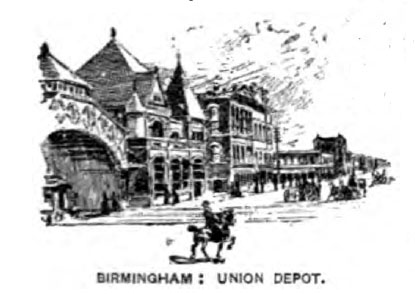
BIRMINGHAM: UNION DEPOT.
and the probate
courts. There are United States District Courts at
Birmingham, Montgomery and Mobile. The Capitol, at
Montgomery, is a substantial building with a many-columned
Grecian portico, and a high dome. It stands on Capitol
Hill, at the head of Dexter Avenue, and dates from 1849.
Here the Confederate Government was organized, Feb. 6, 1861,
and the Confederate Congress held its earlier sessions.
The Alabama State Troops have shown great efficiency at
different times, when called out to support the civil
authorities. They are armed with Springfield
breech-loaders, the artillery including Gatlings, Napoleons
and three-inch rifles. The First Regiment has its
headquarters at Mobile; the Second, at Birmingham; and the
Third at Selma. There are four batteries and two
troops attached to the regiments. Mobile and
Montgomery have colored companies. The State Troops
hold regimental encampments, for a week in summer, and are
inspected by United States army officers.
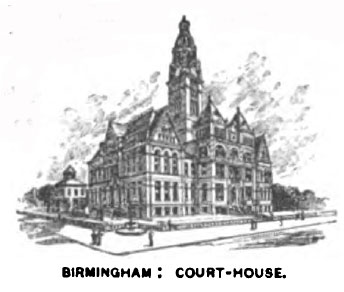
BIRMINGHAM: COURT HOUSE
Charities and Corrections - The Institution for the
Deaf and Dumb, at Talladega, was opened in 1860, and has 53
inmates (whites). The Alabama Academy for the Blind,
formerly united with the above-named, became independent in
1887. It has 30 pupils (whites). The State
Insane Asylum was opened at Tuskaloosa, in 1861, and has 340
inmates. The State Penitentiary at Wetumpka dates from
1841. The county convicts are farmed out to
contractors, and kept in private prisons and convict camps,
where they formerly suffered incalculably from cruel
punishments, vermin and sickness, until, in many cases,
death set them free. Recently, marked improvement has
been made in this system. The Rev. F. H. Wines
of Illinois pronounces Alabama's to be the best example of
the lease system in the Union. The majority of the
able-bodied convicts work in the mines near Birmingham.
The report of the State health officers for 1889 showed a
mortality of 20 per cent. in the Coalburg prison camp.
Alabama has 1,500 insane persons, 2,200 idiots, 1,400 blind,
700 deaf-mutes, 700 paupers, and 1,400 prisoners.
National Institutions - The Mount-Vernon Barracks
occupy a high plateau 28 north of Mobile, with their massive
buildings amid oak and magnolia groves, surrounded by heavy
brick walls. This is one of the handsomest posts of
the army; and dates from 1829, when Andrew Jackson
ordered an arsenal to be established here, on the site of
one of his favorite camp-grounds. In 1873 it was
transformed into a barrack, now occupied by part of the 4th
United States Artillery. In 1889-91 Geronimo, Nana,
Loco, and 380 other Arizona Apaches, prisoners of war, were
quartered here, under active religious and educational
influences. The United States Marine Hospital is at
Mobile. Fort Morgan, 30 miles south of Mobile, was
founded in 1819, on the site of Fort Bowyer, and cost
$1,250,000. Fort Gaines is a pentagonal work on
Dauphin Island, three miles from Fort Morgan, across the
channel. Neither
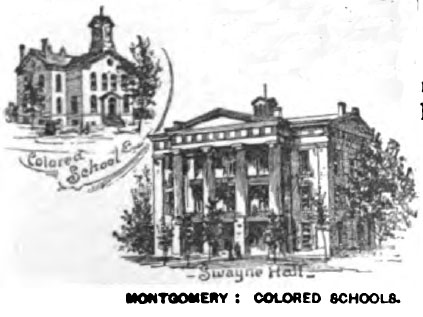
MONTGOMERY: COLORED SCHOOLS
[Page 34]
of these works is garrisoned. The lighthouses are on
Sand Island, Mobile Point (Fort Morgan), Dog-River Bar,
Choctaw Pass and Battery Gladden.
Education, in its higher forms, began with Greene
Academy, at Huntsville, in 1812. A good public-school
system was inaugurated in 1854, but the war and
reconstruction crippled it seriously. The normal
schools have all been founded since 1892, and contain 1,200
students. The normal schools for whites are at
Florence, Jacksonville, Livingston and Troy. In 1880,
Alabama, out of a population of 1,262,505, had 433,477
persons above the age of ten who could not write. This
appalling army of illiterates is mainly composed of negroes
and rustics; and the local educators are making earnest
efforts to secure more and better means to reduce the
prevailing ignorance. Alabama has a school population
of 485,551, with an average daily attendance of 162,516.
The school age is from 7 to 21; the average duration of the
school year, 155 days in the cities, and 70 days in the
country; the yearly expense, $750,000. The Teachers'
Reading Circle, the Colored Teachers' Association, the State
Teachers' Association (white), the Congressional (District)
Teachers' Institutes, and other active agencies are
achieving a good work in raising the educational standard.
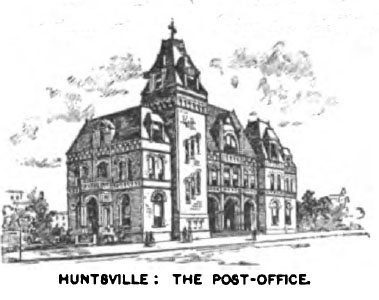
HUNTSVILLE: THE POST OFFICE
The University of Alabama occupies an estate of 500 acres,
at Tuskaloosa, with 18 professors and 240 students. It
was opened in 1831, and has an endowment of $300,000 from
lands granted by Congress in 1802, and held in trust by the
State, which pays eight percent. a year. The National
troops burned the building, in 1865; and there are now four
new edifices, enclosing a quadrangle, with Clark Hall,
containing the great hall and the library (of 9,000
volumes). The three courses are classical, scientific,
and civil engineering, with a law department containing 19
pupils. Military training is a prominent feature.
The State Agricultural and Mechanical College, at Auburn, in
the Cereal Belt, arose in 1872, as one of the National
land-grant schools of science; and has 12 instructors and
250 pupils. The Southern University, at Greensboro,
pertains to the M. E. Church South, and has 12 instructors
and 220 students. Before the war it was a rich
institution, and it is now slowly regaining its former
dignity. Howard College is a Baptist institution,
founded in 1842, at Marion, and since 1887 located at East
Lake, five miles from Birmingham, in the Ruhama Valley.
Spring-Hill College is a Catholic institution near Mobile,
opened in 1830, and with 100 students. The Medical
College of Alabama was founded in 1859, at Mobile, and has
12 instructors and 100 students. There are 35
academies, with 6,000 students, including the colleges for
women at Anniston, Tuskaloosa, Tuskegee, Huntsville,
Tuscumbia, Athens, Eufaula, Florence and Talladega.
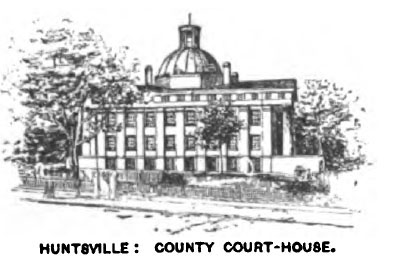
HUNTSVILLE: COUNTY COURT-HOUSE
The
colored people of Alabama have four normal schools, those at
Huntsville and Mobile being older than the white normal
schools. The State Normal and Industrial School was
founded in 1881, as an outgrowth of the Hampton (Va.)
school, and has been very successfully conducted by
Booker T. Washington, an eminent colored educator.
Its corn-fields, orchards, workshops and buildings occupy an
old plantation near the patrician town of Tuskegee, in the
Black Belt. The State makes a yearly appropriation,
paying part of the expenses of this school, which has 600
earnest and industrious students. Talladega College
was founded by the American Missionary Association in 1867,
and has several buildings, and large tracts of farm-lands.
There are 427 colored students, none of them collegiate.
The theological school for Congregational ministers is at
Talladega; that for Baptists is at Selma University; and the
Presbyterian conduct an institute for training colored
ministers, at Tuskaloosa.
[Page 35]

BIRMINGHAM: SLOSS IRON AND STEEL CO.
The State has 3,000 Sunday schools, with 20,000 teachers
and 160,000 pupils. The religious proclivities of the
people incline toward the Methodist and Baptist sects, the
first having above 200,000 members, and the second 175,000.
There are 12,000 Presbyterians, and 4,000 Episcopalians.
Newspapers came to Alabama in 1812, when Pasham
started the Madison Gazette at Huntsville. St.
Stephens followed with The Halcyon, in 1814; Mobile
with The Gazette, in 1816; and Tuskaloosa with The
Republican, in 1818. The Florence Gazette,
Montgomery Republican and Claiborne Clarion
appeared in 1820. Alabama now has 169 newspapers (15
daily, 144 weekly, and 8 monthly), with an average
circulation of 681 copies. Prominent among these are
the Mobile Register (founded in 1820), Montgomery
Advertiser (1828), Selma Times-Mail (1825), and
Birmingham Age-Herald.
The Chief Cities of Alabama (except Mobile) are
modern, and some of them have risen with marvelous rapidity
in the last 15 years. Mobile, successively French,
English, Spanish and American,
and the commercial
metropolis of Alabama, is one of the chief cotton-depots in
the Union, and sends away 230,000 bales yearly, mainly by
railway. There is also a large trade in lumber and
timber, general merchandise and coffee, coal and naval
stores, besides many profitable manufactures. The
broad and quiet streets are shaded throughout with live-oaks
and magnolias, and the gardens are fragrant with the
perfumes of the jessamine and the orange. Government
Street has many beautiful and embowered residences; and the
Shell Road is a famous harborside drive. The city
enjoys extensive railway connections, and has steamship
lines to New York and Liverpool. Montgomery, near the
centre of the State, is a growing city, with artesian water,
street-cars, and electric lights, a prosperous railway

BIRMINGHAM: SLOSS IRON & STEEL CO.
centre, and a winter
resort for Northerners, who enjoy its soft air and embowered
streets. It is one of the old-time Southern cities,
with an environment of large-pillared country seats,
nestling in live-oak groves, and a State Capitol overlooking
a great expanse of country, through which flashes the
silvery line of the Alabama River. Since 1865, the
population has quintupled, and many factories have sprung
up. One hundred and thirty thousand bales of cotton
and handled here yearly.
Birmingham, the foremost city of Alabama, is in Jones
Valley, six miles from Red Mountain, which contains millions
of tons of hematite iron ore, close to inexhaustible
supplies of coal and limestone. Founded in 1871, by
the Elyton Land Co., it has become "the Magic City of the
South," with the largest rolling mills below Richmond,
manufacturing rail and bar iron, plate and sheet iron, and
factories for making ice, glass, stoves, bridges, chains,
steel cars, and many other articles. It is recorded
that Krupp, the Iron King of Europe, said: "Should
fate drive me from Germany, I would go to Birmingham,
Alabama;" and the London Times prophesied that this
is bound to become the greatest metal-workers' city in
America. The

ANNISTON: ST. MICHAEL'S AND ALL ANGELS.
[Page 36]
contiguity of the iron and coal makes it possible to produce
the metal at the lowest possible cost for labor; and the
convergence here of six railways gives unusual facilities
for shipment. Twenty-five furnaces are now at work in
and near this city, giving cheap iron to the world.

BIRMINGHAM: JOSIAH MORRIS BLOCK
One of the pioneers in the
astonishing development of Alabama's mining industries was
the Sloss Furnace Company of Birmingham, which
afterwards bought the Coalburg Coal and Coke Company, and
formed the Sloss Iron and Steel Company. This vigorous
corporation has a paid-in capital of $3,700,000, and employs
3,500 men, with large mines, 800 coke-ovens, and four
furnaces, adequate to the production of 450 tons of pig-iron
daily. Here the world's problem of cheap iron is being
solved, where the ore of Red Mountain, that mineral marvel
of America, is manufactured into the best quality of metal,
capable, with proper treatment, of successful competition
with the finest Russian and Norway iron.
At Birmingham, too, is the Morris Block, erected
and owned by Josiah Morris, the millionaire banker of
Montgomery, who was one of the earliest investors in the
present city, and by whose aid the enterprise was carried
through some of its earlier trials. This is one of the
finest and costliest office buildings in the South, an
architectural credit to the city, and thoroughly fire-proof.
It is occupied by banks and for offices of many kinds.
Its upper floors have been utilized as the Morris
Hotel, on the European plan, the rooms being the choicest in
the city.

ANNISTON:
THE ANNISTON INN.
Anniston, one of the loveliest cities of the South, and also
one of the most remarkable centres of the Iron industry in
the country, rests on a healthy and pleasant plateau of
northeastern Alabama, 900 feet above the sea, amid the
picturesque wooded spurs of the Blue Ridge. Here the
Georgia Pacific and the East-Tennessee, Virginia & Georgia
Railroads intersect; and the Alabama Mineral Railroad runs
northwest to the Queen & Crescent system, at Attalla, and
southwest to the Georgia Central system, at Sylacauga.
Anniston is built upon the surrounded by enormous beds of
brown hematite ore, easily accessible and cheaply mined, low
in silica and phosphorus, and containing above 50 per cent.
of metallic iron. The first-class coking coals of the
Coosa and Cahaba mines are respectively within 25 and 45
miles; and the Anniston valley abounds in limestone for
fluxing. Seven charcoal furnaces make yearly 50,000
tons of tough car-wheel iron; and two coke furnaces make
100,000 tons of pig-iron. On this site a furnace was
built and destroyed during the Civil War. Samuel
Noble, a practical English iron-worker, then running a
foundry at Rome, Georgia, visited the ruins about the year
1870, and becoming impressed with the enormous deposits of
ecellent brown iron ore, bought up large areas, upon which
the Woodstock Iron Company started its first furnace in
1873, and a second in 1879. Associated with Mr.
noble in

ANNISTON: NOBLE
INSTITUTE FOR BOYS.
[Page 37]
the foundation of the city were Gen. Daniel Tyler and
Alfred L. Tyler; and the new settlement received the
name of Annie's Town (contracted to Anniston), from the
Christian name of Mrs. Alfred L. Tyler. Until
1883 the great domains of the Woodstock Company were
withheld from public sale, and during that period the
corporation built streets and parks and laid out a model
city, at great cost. Then they began to sell building
lots, and the city flashed into life, with a host of
manufacturing industries, making iron, steel, stoves,
horse-shoes, furniture, brick, ice, and many other articles,
mainly dependent

ANNISTON: GRACE CHURCH. NOBLE
INSTITUTE FOR GIRLS; THE SCHOOL AND DORMITORY
on
the molten ore of the furnaces. In 1887 the land
interest of the Woodstock Company, was sold to the Anniston
City Land Company, which now owns nearly $5,000,000 worth of
property, including 2,700 acres in the city, the Inn, and
many dwellings. The country about Anniston is very
fertile, especially along the Choccolocco and Alexandria
Valleys, and among its other products the city receives
60,000 bales of cotton yearly. Under these favorable
circumstances, Anniston has constructed a capital cotton
compress, and one of the largest cotton-mills in the South.
The Anniston Inn is a handsome Queen-Anne building, with
broad verandas and a richly decorated interior, standing on
an eminence near the centre of the city, and commanding fine
views of the mountains. Anniston ahs 25 churches, the
chief of which is the great stone and marble edifice of St.
Michael's and All Angels, crowning a beautiful hill that
overlooks the city and its mountain-guards. This noble
ecclesiastical structure was built in 1889-90, by John W.
Noble, as a memorial of his father, James Noble,
and his brother, Samuel E. Noble, one of the founders
of the city. Noble institute for Boys and noble
institute for Girls were established by Samuel E. Noble,
in recognition of the fact that in this beautiful new city
of Mountains the best educational facilities should be made
ready for the young people. The two institutes are of
a high grade, with first-class faculties, abundant
laboratory and other facilities, and carefully planned
courses in the classics, languages, science, art and music.
The buildings are handsome and elaborate architectural
works, in pressed brick and stone, and provided with all
modern improvements and conveniences.
The interesting development of the new Alabama cities
marks the dawn of a new era in one of the most conservative
of the Southern States. The fact that the pig-iron
product of the United States now exceeds that of Great
Britain, and reaches nearly 10,000,000 tons a year, marks
one of the most notable of modern industrial revolutions.
In 1880, Alabama was the tenth State in respect to the
production of iron, but now she occupies the third place,
and yields one tenth of the American output, and one half of
the pig-iron made in the South.

DECATUR: THE MANUFACTURING QUARTER.
As a producer of iron ore, Alabama now stands second only to
Michigan, having passed Pennsylvania and New York, and
yielding 1,570,000 tons yearly. This is the cheapest
iron in the world, owing to the large open workings and the
easy facilities for mining, which also enable the local
mining companies to get out the ore for 69 cents a ton for
labor, which also enable the local
mining companies to get
out the ore for 69 cents a ton for labor, which is a lower
rate than
[Page 38]
obtains anywhere else in the United States, the average
American expenditures for wages per long ton being $1.06.
The capital invested here in iron-ore mining is above
$5,000,000, the entire American investment in this line
being $110,000,000.
The most valuable ally of the iron manufacture here is
the coal-mining industry, which bean in a small way in 1853,
and reached by 1876 a yearly output of 100,000 tons, mainly
for local use. This product has now increased to
nearly 4,000,000 tons; and 7,000 men are employed in its
manipulation. The three great coal-fields cover 8,660
square miles, lying along the valleys of the Warrior, Coosa
and Cahaha Rivers, and bearing their names. The
product includes all the bituminous varieties, such as gas,
coking, block, splint, and canned, and provides the growing
local industries with inexhaustible supplies of fuel for
steam and furnace users, and for domestic purposes.
Jefferson County (of which Birmingham is the capital)
produces more than two thirds of the Alabama coal; and Bibb
and Walker Counties come next, each with about 500,000 tons
a year.

TUSCALOOSA:
UNIVERSITY OF ALABAMA
The development of the wonderful mineral resources of the
State has been aided by the Geological Survey, which has
been in progress since 1873, under the direction of the
State Geologist, Dr. Eugene A. Smith, of the
University of Alabama. Reports have been published
almost yearly, and the survey had prepared an elaborate
museum of minerals for the University. this is one of
the benefits accruing to the State from its great
educational institution, whose teachings are made general
and popular by the appointment of three free students from
each county. Many of the leading men of Alabama were
educated at the University, which is charmingly located in
the cultivated city of Tuskaloosa, whose broad streets,
shaded by the native water-oaks, run down to the Warrior
River, at the head of steamboat navigation, in a rich cotton
district. Steamboats run regularly between the
university city and Mobile, the great sea-port of Alabama.
The intelligent development of the material wealth of
the hills has caused the active and growing city of Bessemer
to grow up on the lone fields of an Alleghany glen. A
solitary log-hut stood here at the middle period of
President Cleveland's administration, where now the
spires and factory-chimneys of an industrial metropolis are
outlined against the deep green of the mountains.

BESSEMER:
OFFICE OF THE BESSEMER LAND AND IMPROVEMENT CO.
Bessemer was founded in 1887, and within three years arose
to the position of an important manufacturing city and
railway centre, with seven furnaces in full blast, large
rolling mills and cast-iron pipe-works (capacity 350 tons
daily), fire-brick works, and many smaller industries,
besides handsome public buildings and business blocks, eight
churches, and two newspapers. The reason for this
extraordinary development is found in the existence here of
a long mountain-range of iron, occurring in veins from five
to 20 feet thick, and containing billions of tons of ore,
under conditions of surprising economy for development.
The ore can be mined and delivered at the furnaces for 55
cents a ton. Within 25 miles there are 600,000 acres
of coalfields, estimated to contain 30 billion tons, and
yielding 62½ per cent, in coke.
The great mines
Page 39 -
on this belt deliver coal in Bessemer at 80 cents a ton.
The purest Trenton limestone abounds in Jones Valley, and is
delivered in the city of 60 cents a ton. With these
notable advantages, iron is manufactured here at a minimum
of cost, and completes with the cheap iron of England.
The city stands 600 feet above the sea, in the beautiful
amphitheatre of Jones Valley, between Red Mountain and Rock
Mountain, 13 miles below Birmingham. It gathers nine
railways into its arms, and confidently looks for a great
future development in general manufacturing and as a
trade-centre. The founder and chief owner of this iron
city of North Alabama is the Bessemer Land and Improvement
Company, which is conducted with an enterprise and sagacity
that make it certain that in the course of a few years
Bessemer will fairly rival all of its older neighbors.

BESSEMER: THE CHARLESTON BLOCK
BESSEMER: MONTZUMA HOTEL
The De Bardeleben Coal and Iron Company, Consolidated,
is the great mainspring of the life of Bessemer, and
owns seven new and fully equipped blast furnaces, with a
daily capacity of 800 tons; seven iron-mines, yielding
4,000 tons daily; seven coal-mines, with a

BESSEMER: DE BARDELEBEN COAL AND
IRON CO.
daily
capacity of 5,000 tons; 900 coke ovens; 25 miles of
standard gauge railway; immense limestone quarries; and
numerous other valuable properties. In 1889 the De Bardeleben Company consolidated with the Bessemer Iron
and Steel Company and other corporations owning
vast areas of coal and iron lands, and formed a new
company, with $10,000,000 capital, and employing 2,000
men. The mineral lands cover 140,000 acres, and
the yearly output of the furnaces is 250,000 tons of
pig-iron, worth $4,000,000.
Sheffield is another of the interesting new cities of
northwestern Alabama, with its fortunes securely based
on the manufacture of iron. It was founded in
1885, on a bold bluff midway between Tuscumbia and
Florence, and fronting on the broad and deep Tennessee
River. Unlimited supplies of fine brown iron-ore
and the best of coking coal are available within 20
miles, and have resulted in the erection here of five
blast-furnaces, with a capacity of 700 tons of pig-iron
daily. The ores are of remarkable excellence,
requiring only a pound of coke to make a pound of metal,
and producing but little slag. A great advantage
enjoyed by this "Iron City on the Tennessee River" is in
the low price of freights by water, amounting to but $1
a ton to St. Louis. Many important ports on the
Tennessee, Ohio and Mississippi are reached by
steamboats from this city; and railways run to
Birmingham and other points. The Sheffield Land,
Iron and Coal Company enjoys the honor of having founded
this hive of industry and commerce, with its busy
factories and fine public buildings, where five years
ago stretched the lonely fields of a rural plantation.

SHEFFIELD:
THE SHEFFIELD HOTEL.
The magnificent inland water-way of the Tennessee River,
navigable now from North Carolina to the Ohio, is becoming a
notable highway for iron and coal, cotton and grain, outward
bound from North Alabama, and delivered at many cities of
the West and Northwest. Even such dignified and
ancient communities as Florence are being forced, by the
demands of New South
[Page 40] -

FLORENCE: SYNODICAL COLLEGE.
makes upon them, on
account of their unrivalled commercial strategic value, to
exchange their placid seclusion for a new civic life, full
of energy and enterprise.
Florence, a pleasant old Alabama college-town, on a
rolling plateau in the cotton region of the north somehow
was drawn into the resistless whirl of modern activity in
1887, and within two years the population increased
five-fold. It has the same remarkable combination of
iron, coal river commerce, by which the products of its
mills can be delivered in the North at trifling charges for
freight. Iron is freighted by steamer to St. Louis for
$1 a ton. The advantages of the site have drawn to
this beautiful river-city a number of large manufacturing
companies, and many millions of Northern capital, covering
widely diversified interests; and it is thought that
Florence will become one of the half-dozen chief cities of
the South. The chief development corporation of this
locality has been the Florence Land, Mining and
Manufacturing Company, which started its development in
1887, and has continued it.
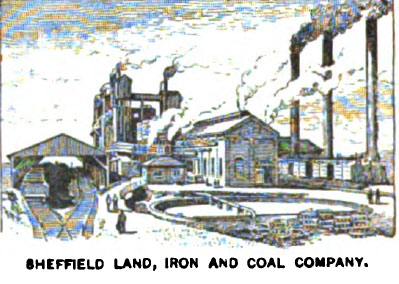
SHEFFIELD LAND, IRON AND COAL COMPANY
Many other manufacturing towns have been started in Alabama.
Some of them will succeed, in greater or less measure, and
others will remain names and nothing more. Thus the
old-time Chickasaw, at the foot of Colbert Shoals, in the
farm northwest, bloomed out in 1890 as the coming city of
Riverton, with iron-furnaces to be, and basic steel plants,
and elevators. So also Pell City seeks to rise, where
several railways intersect, in the rich Coosa Valley.
Fort Payne was founded in 1889, by New Englanders, who
bought 32,000 acres of land here, with the coal-seams of
Lookout Mountain on one side, and the iron ores of Red
Mountain on the other, and beds of limestone between.

IRON MINES: DE BARDELEBEN COAL & IRON CO.
Bluffton stands high on
the Eastern-Alabama foot-hills, with cliffs of hematite iron
ore all about it, furnishing material for several active
furnaces. Decatur, on the broad and navigable
Tennessee, and in the cereal belt, was a war-shattered old
village of 1,500 people early in 1887, when New Decatur
arose, to be a city of 8,000 people. Selma, on the
Alabama, is an important cotton-market, manufacturing town,
and railway centre. Huntsville, famous for its great
flowing spring, is a capital of the richest of the Tennessee
Valley counties, with profitable manufactures and a
beautiful surrounding country. Eufaula stands perched on a
bold bluff over the Chattahoochee. Tuskaloosa is a
city of 5,000 people, on the Warrior River, between the rich
corn and cotton fields of the valley and the famous Warrier
coal-fields. Talla-

SHEFFIELD LAND, IRON AND COAL CO.'S OFFICE
[Page 41] -
dega, Stevenson, Attalla, Gadsden and other new
municipalities, are fast coming into public view.
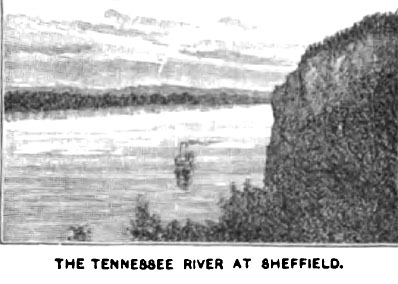
THE TENNESSEE RIVER AT SHEFFIELD.
Railroads were initiated here by the Tuscumbia,
Courtland & Decatur line (44 miles) in 1831-4. The
State now contains over 3,000 miles of tracks, the chief of
which are the Alabama Great Southern, from Chattanooga to
Meridian, with 245 miles in Alabama; the South & North, from
Montgomery to Decatur, 189 miles; the Mobile & Montgomery,
178 miles; the Selma Division of the East-Tennessee,
Virginia & Georgia Line, with 172 miles in Alabama; the
Meridian and the Mobile and Birmingham Divisions; the
Georgia Pacific, 241 miles; the Memphis and Charleston, 151;
the Alabama Midland, from Montgomery to Bainbridge, Ga.; the
Savannah & Western, 156; the Alabama Mineral, 127; and
the Kansas City, Memphis & Birmingham, 118. The other
roads, 25 in number, have each less than 100 miles of track.
The railroads include those from Mobile northeast to
Montgomery and to Atlanta, from Mobile north to Selma and
Birmingham, from Mobile northwest to Meridian, Miss. (and
Cairo and St. Louis); from Meridian east to Selma and
Montgomery, from Montgomery to Troy, Columbus and Opelika (a
loop line); from Selma across the Coosa Valley to Talladega
and Rome; from Mobile east to Pensacola and west to New
Orleans; and along the Tennessee Valley. The
magnificent systems of the East-Tennessee, Virginia &
Georgia Railway and other lines afford capital facilities
for passengers and freight from Central Alabama
northeastward to Chattanooga and the North, eastward to the
first-class seaport of Brunswick (Ga.), and southwestward to
Mobile and the Gulf ports. The East-Tennessee,
Virginia & Georgia connects also with the Atlantic Coast
line at Jesup. The Mobile & Ohio Railroad traverses
the rich farming territory of the Alabama Land & Development
Company, in the southwestern counties.

TUSCUMBIA: COUNTY COURT-HOUSE
Navigation by canoes was superseded by flat-boats,
taking three months from Mobile to Montgomery; and in 1818
the St. Stephens Steamboat Company received incorporation,
followed by the Steamboat Company of Alabama. The
early boats took 15 days to go from Mobile to Montgomery.
There are now 43 steamboats (21 for passengers) on the
rivers, with a tonnage of 7,008, and a value of $250,000.
From the high bluffs along the river, cotton is sent down to
the boats on slides, and passengers use long stairways.
Alabama also has 73 sailing-vessels, of 8,000 tons.
Mobile is the only port in the State, and her commerce has
declined seriously, on account of railway competition and
discrimination - New Orleans and the Atlantic ports taking
her cotton exportations, and Pensacola shipping the lumber.
Mobile's exports were $22,500,000 in 1870. In 1878,
they had fallen to $9,000.000.
Manufactures are mainly in the northern
counties, where the recent development of vast coal and iron
deposits has revolutionized and country, causing the rise of
new manufacturing cities, like Birmingham, and Anniston,
Florence and Sheffield, and followed by the building of many
furnaces and rolling-mills. In 1880 there were 2,000
factories, with $10,000,000 capitall, employing 10,000
operatives, and with an annual product of $14,000,000.
The chief items were $4,315,000 in flour and grist-mill
products, $2,650,000 in sawed lumber, $1,452,000 in iron and
steel, and $1,352,000 in cotton goods. The
manufacturing interests of Alabama have increased
prodigiously

FLORENCE: NORMAL SCHOOL [Page 42]
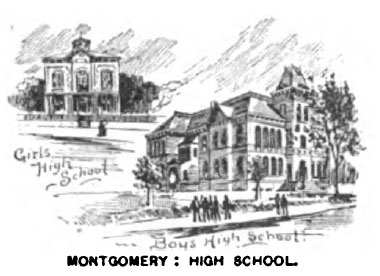
MONTGOMERY: HIGH SCHOOL
within the past decade,
especially in iron and steel and the connected industries.
The largest cotton-mills are at Tallassee, 35 miles from
Montgomery, at the great falls of the Tallapoosa, where 500
operatives are kept at work, in commodious stone factories.
The works were started in 1845, and the present mill dates
from 1854, having been built at a cost of $400,000.
During the Secession War, fire -arms were made here, but now
the products are sheetings, shirtings, duck, and cotton rope
and yarn.
The Finances of Alabama show an estimated valuation
of $378,000,000, with a State bonded debt of $9,240,000
(besides $250,000 unfunded), and county and municipal debts
of about $5,000,000. The yearly State, county, and
municipal taxes are above $2,000,000 yearly. The first
bank was founded at Huntsville in 1816. There are now
21 National banks, with about $3,500,000 capital; and six
savings-banks, with deposits of $1,300,000. There are
also seven State banks with a capital of $700,000.
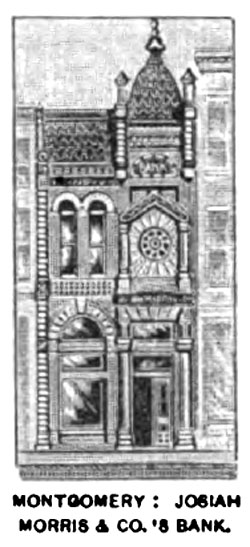
MONTGOMERY: JOSIAH
MORRIS & CO.'S BANK.
The
banking-house of Josiah Morris & Co. is the
pre-eminent private financial institution in Alabama, and
exercises an important and progressive influence in
Montgomery, the capital of the State, as well as in the
great mineral regions of Central and Northern Alabama.
Josiah Morris originated on the Eastern Shore of
Maryland, in 1818, and, after a number of years of active
business in Georgia and Louisiana, in 1851 he settled at
Montgomery, where his close attention to business and his
keen insight have been the corner-stones of a wonderfully
successful career. The firm has helped the great
railroad enterprises of this section with counsel and
credit; and especially has contributed largely to the
building of the South and North line, and the consequent
development of Birmingham. The large and increasing
business of this house has compelled the erection of a new
banking building, which is an ornament to the capital of
Alabama. Mr. Morris's associate is F. M.
Billing. Josiah Morris & Co. carry on a
general banking business.
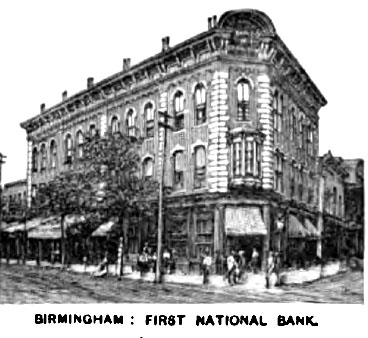
BIRMINGHAM: FIRST NATIONAL BANK
The
First National Bank of Birmingham, although established
within a very few years, now occupies a proud position among
the financial institutions of the South, and has the largest
deposits and does the largest business of any bank in the
State of Alabama. With a paid-in capital of $250,000,
this corporation already ahs a surplus exceeding $200,000;
and its first class fund. The efficient aid of such a
powerful financial institution as this has been wisely
exerted to advance the prosperity of Birmingham in many
ways, and to build up and sustain the great industries which
have risen here. At once conservative and
enterprising, the First National has continually developed
its opportunities and resources, with an unwavering faith in
the iron wealth of the Alabama hills as the true foundation
for a powerful monetary institution; and the result has
amply justified the sagacity of the undertaking. Its
building was the first three-story brick structure in
Birmingham, erected for this bank in 1872, by Charles
Linn, in an old corn-field, and then known all over
Alabama as "Linn's Folly." The First National was
organized in 1884, by the consolidation of the National Bank
of Birmingham and the City Bank. Then there were two
banks in the city, where there are now twelve.
|