|
RED HOUSE
<
CLICK HERE to RETURN
to TABLE of CONTENTS >
THIS town
embraces all of the township 1, and nearly all of township 2, in the
seventh range of the Holland Survey. It is the youngest town
in the county, and was erected from Salamanca, Nov. 23, 1868.
The name was derived from the principal creek of the town, which was
so called before the country was settled, from a house painted red,
which stood near its mouth, and which was built for the
accommodation of raftsmen on the Allegany. The eddy formerly
in that stream at this point was also called Red House. Who
was the proprietor of this house and what became of him is unknown
to the present inhabitants of the town. The building has long
since gone to decay.
The town contains 36,392 acres of land, mostly broken
and of a mountainous nature. The summits rise from 600 to 1000
feet above the valleys, and usually present a sterile aspect.
There is but little arable land on the uplands, and as the Allegany
Reservation embraces nearly all the valley of the river, but little
land is subject to improvement by the whites. Although the
soil in the valleys is fertile and highly productive, but a small
portion is thoroughly cultivated. On the lowlands the soil is
a sandy loam, but becomes more mixed with clay as you ascend the
hills. Lumbering has been and yet remains the controlling
industry. In the southern part of the town are vast forests of
deciduous trees, and a limited quantity of pine and hemlock.
Originally the valleys were covered with the latter
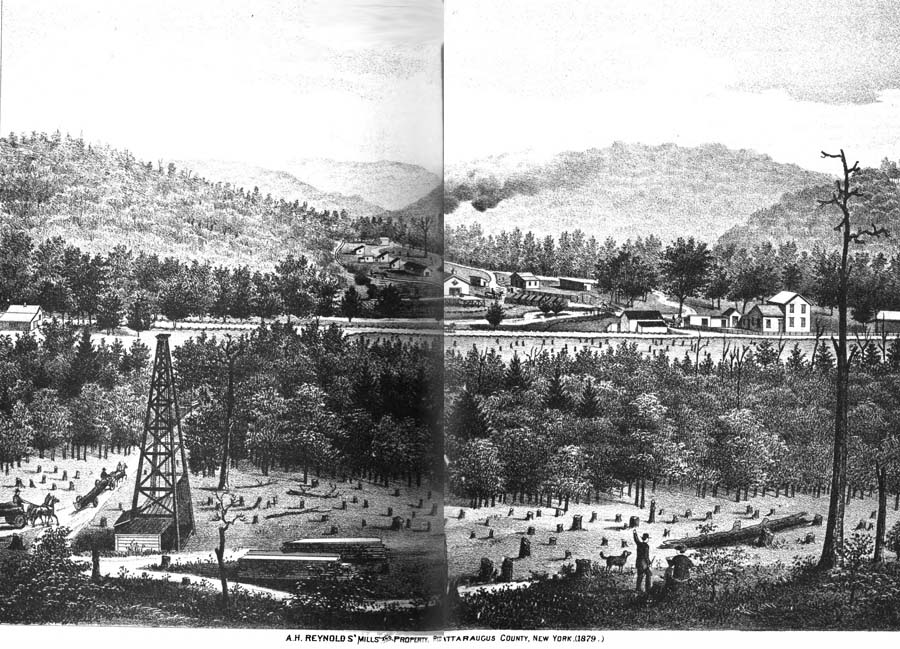
A. H. REYNOLDS' MILLS & PROPERTY,
CATTARAUGUS CO., NY - 1879
[Page 503] -
timber, and their manufacture into
lumber was an extensive and profitable business.
The streams of the town are Allegany River, flowing
through the northwest corner, and Big and Little Red House Creeks,
rising in the southern part of the town, and flowing north and west
into the Allegany. Both have many tributary brooks. In
the southern part of the town are also the head-waters of Quaker
Run, which flow north west into the town of South Valley.
PIONEER SETTLERS
In 1827,
Darius Frink moved from his native place, Sterling,
Conn, to the town of Carroll, in Chautauqua County, where he lived a
year; then came to the present town of Red House, settling on the
little creek, where he became the first permanent settler in town.
For many years he was the only white man living in these parts.
He had a son named Nelson, who lived in the town till his
death, a few years ago. The last twenty odd years of his life
he lived on lot 18, in town 2, where one of his children, James
Frink, now resides.
James Rosenberry, a native of Butler Co., Pa.,
was the second permanent settler, locating on lot 31, in 1837.
While but a young man, in 1815, Rosenberry went to Great
Valley, and worked there about a year; then moved to the present
town of Salamanca, where he settled on the farm now occupied by
W. P. Crawford. Mr. Rosenberry is now the oldest
resident in town, and although aged eighty-two years, still works on
his farm, on which he has cleared 100 acres, removing many stumps
four feet in diameter.
On the Big Red House, Lysander Whaley was
an early settler, removing from there to the West. On lot 18
originally lived Caleb Owens, and removed from there
to Steamburg, where he was murdered in 1874. On this place-lot
18, town 2 - now resides Howard Fuller, who came to
Cattaraugus County in 1820, settling first in the town of Randolph,
then removed to Pennsylvania, coming to Cold Spring in 1839.
Thirty years thereafter, he came to live with his son Howard,
who became a resident of Red House in 1858. The old gentleman
has attained the age of eighty-two years, and has been a pioneer in
several towns of the county.
Other early settlers in Red House were Elijah
Pease, Squire Payne, Hubbard Clark,
William Coan, Richard Wright, Abner
Thomas, Marcus Frisbie, Richard
Burgett, Sylvester Dunbar, Stephen Carr,
George Decker, Francis Strickland,
David Kelley, and Ezekiel R. Kelley. In
consequence of the conditions alluded to, settlements were slowly
made.
In 1869 land was owned in town by the following
persons: C. W. Bosworth, Abner Brown, Nelson Bean, T. E. Bristol,
R. Burgett, Stephen Carr, Howard Carr, William Clark, S. V. Dunbar,
George Decker, James Eighme, Nelson Frink, E. Flanders, Howard
Fuller, T. Grove, Noel Gray, Lyman Jeffords, D. N. Kelly, E. R.
Kelly, Henry Learned, Joseph Mead, Caleb Merritt, Henry Oaks, H.
Ogden, S. F. Pease, Robert Philip, James Rosenberry, A. H. Reynolds,
J. B. Strong, F. Strickland, Giles Stoddart, John Sharp, C. W.
Sharp, Abner Thomas, Allen Tibbitts, E. W. Taylor, S. D. Woodford,
Martin White.
The Bay State Company owned nearly 20,000 acres of land
in the southern part of the town.
The population in 1870 was 407, and in 1875, 453;
nearly all of whom were whites.
CIVIL GOVERNMENT
The first
annual meeting of the town of Red House was held Feb. 23, 1869, when
the following officers were elected: Supervisor, F. Strickland;
Town Clerk, T. E. Bristol; Justices, John Sharp, D. A.
Scoutten, F. F. Deyo, and S. D. Woodford; Commissioner of
Highways, Abner Brown; Assessors, E. R. Kelly, Nelson
Frink, and F. Strickland; Inspectors of Elections, F.
F. Deyo, J. F. Eighme, and J. W. Crosby; Collector,
Daniel Carr; Overseer of Poor, J. C. Wright; Constables,
Albert Sheffield, Daniel Carr, Wm.
Critchell, S. F. Pease, and Wm. Backus.
Since 1869 the principal officers have been:
| |
SUPERVISORS |
TOWN CLERKS |
| 1870 |
Howard Fuller, Jr. |
George Haynes. |
| 1871 |
Richard Burgett. |
F. J. Eighme |
| 1872 |
Clark W. Bosworth |
S. F. Pease |
| 1873 |
E. R. Kelly |
Wm. C. Flanders |
| 1874.......... |
"
" |
S. D. Woodford. |
| 1875.......... |
S. D. Woodford. |
A. A. Casler |
| 1876 |
Clark W. Bosworth. |
Thomas Rosenberry |
| 1877 |
E. C. McIntosh |
Daniel Carr |
| 1878 |
L. J. Darling |
S. M. Wetmore |
JUSTICES OF THE PEACE
| 1870. |
E. W. Taylor
Wm. C. Flanders |
1874. |
James F. Eighme.
Wm. C. Flanders |
| 1871. |
D. W. Kelly
S. F. Pease |
1875
1876. |
F. Strickland
John Brinning |
| 1872.
|
John Sharp |
1877. |
S. D. Woodford |
| 1873. |
Wm. J. Banks.
S. D. Woodford |
1878. |
Wm. Preston
S. M. Wetmore |
PUBLIC THOROUGHFARES
At
the spring session of the town board, in 1869, the following
resolution was passed: "Resolved, that the supervisor of the
town of Red House be authorized to borrow money and issue the bonds
of the town for the same, not to exceed $6000, for the purpose of
erecting a bridge across the Allegany River in said town; the bonds
to be payable, one-third yearly until paid with interest."
At a
special meeting, Oct. 15, 1870, $1000 was appropriated to build
approaches to this bridge; adn at another special meeting, December
12, the same year, the supervisor was authorized to send H.
Ansley to Albany to solicit an appropriation from the State to
go towards paying the bridge, "and that the amount to be paid the
said Ansley shall not exceed $300."
Mr. Ansley succeeded in getting an appropriation
of $3000 for this purpose.
This b ridge is near Red House station, and is a
substantial structure, more than 500 feet long. It is the
second one that occupies this site, the first one having been
erected in 1860. The expense of its construction was defrayed
by a tax of 7 cents an acre on the lands of the citizens living on
the south side of the river.
In 1873 the town appropriated $600 for the support of
roads and bridges; and at subsequent meetings $500 per year was
voted for the same purpose. The town is divided
[Page 504] -
into five road districts; and, considering the meagre population,
possesses good roads to the principal points within her bounds.
The Atlantic & Great Western Railroad passes down the
right bank of the Allegany River, having nearly 3 miles of track in
Red House.
A station and side-tracks for shipping purposes have
been provided at Red House, nearly 6 miles below Salamanca.
LUMBER MILLS
The first
saw-mill in town was put up on the Little Red House Creek, about
1849, by Hubbard Clark, Marcus Frisbie,
and several others. It has long since been abandoned.
The Bay State Lumber Company put up the next mill,
operated by steam, about 1853, on lot 64, in town. It has a
good capacity, and when in operation creates a great deal of
business in that locality. The mill has been idle the past few
years.
A short time after the above was erected, James
Appleby put up another steam saw-mill on lot 27, which was there
operated until the timber was exhausted, when the machinery was
removed to lot 28, and put into a new mill, which has been operated
since 1870 by J. F. Eighme. It is capable of cutting
20,000 feet per day, and when all the machinery is operated employs
10 men.
On lot 28, John Sharp has operated a
shingle-mill, cutting 5000 per day, since 1870.
In the same year Patterson's steam saw-mill, on
lot 6, was put in operation. Before that period it was a
water-power mill.
On lot 8, a steam saw-mill of 10,000 feet per day
capacity was built by William Brown, in 1877, and the
same year Elias C. McIntosh commenced operating a mill on lot
9, which has a capacity of 15,000 feet per day.
On Big Red House Creek, on lot 7, Francis
Strickland had a mill for the manufacture of shingles, twenty
years ago, in which, at a later date, steam-power was employed.
In 1872 it was destroyed by fire.
About 1860, A. H. Reynolds had in operation a
saw mill on the Allegany, half a mile above the bridge, which was in
1872 removed to lot 24, where it is now largely operated, cutting
yearly thousands of feet of hard lumber.
Clark W. Bosworth has in successful operation,
on lot 15, a shingle-mill, and formerly had a steam saw-mill, which
was destroyed by fire. A shingle-mill is also operated by
Ellis & France, on lot 21, and another by William
Reynolds, since 1877
L. J. Darling's handle-factory, on lot 18, was
erected in 1873, by Darling & Gibbs. Six men are
employed in the manufacture of long handles from the excellent
white ash growing in that locality.
These lumber interests have given employment to a large
number of men, and in prosperous times made the business of Red
House as active as that of any other town of like area. At
present, trade is somewhat depressed and limited almost entirely to
the Indians.
THE STORES AND TAVERNS.
were usually kept at the station
or in its vicinity. The Bay State Company kept the first store
in town, at its mills, and goods were sold there until work was
suspended, in 1875. At the station, Theodore Bristol
began business, in 1866, and continued in trade four or five years.
He was followed by Wendell & Merritt and Wetmore
Brothers. S. M. Wetmore transferred the business,
in 1878, to the Indian hamlet on the opposite side of the river.
Here, at another stand, the Casler Brothers and
Mrs. Maybee have been in trade.
The Red House post-office was established in 1869, with
Theodore Bristol postmaster. He was succeeded by
Caleb Merritt, and he, in turn, by S. M. Wetmore,
the present postmaster. Two mails per day are received.
The only regular public-house in the town was put up at
the station, in 1871, by Richard Burgett, and is still
continued by him as a tavern
There is no hamlet of whites in the town, the cluster
of houses at Red House being the only place that approaches a
hamlet, but is prevented by its being on the Reservation from
becoming a more important place.
SCHOOLS AND RELIGIOUS SOCIETIES.
In 1878
the town had four school districts, provided with buildings having
an aggregate value of $1885. The total number of weeks of
school taught was 122; the schools were supported at an expense of
$913.82, of which sum $544.17 was raised by taxation in the town.
The children of school age numbered 149, and the average attendance
was 45. The first school-house was built in 1851, on the
Little Red House, and there Caroline Barnes was the
first teacher. An Indian school is also taught on the
Reservation.
In school district No. 2 worshiped a class of
Methodists, which disbanded before 1870. Since that period the
United Brethren have maintained regular preaching there, the
ministers being the Revs. Reeves, Hodge,
Butterfield, Allen and Robinson. There is a
class of 15 members, under the leadership of William
Dunbar.
Missionary services have been held among the Indians of
the town by the Baptists and the Methodists, and on the 2d of
December, 1860, the latter organized a church society, having
Dodge Fatty, John Doxtater, Isaac
Jemison, Payson Jemison, Foster Payne,
Harvey Payne, and James Rosenberry as
trustees. Nothing further has been done, and services are now
only irregularly held.
The Greenwood Cemetery Association of Red House
was formed at the school-house in district No. 2, Nov. 11, 1870, of
eleven persons as incorporators.
The trustees chosen were Nelson Frink, Robert H.
Phillips, Samuel F. Pease, Samuel D. Woodford, Lyman H. Oakes,
Francis Strickland, Sylvester V. Dunbar, Abner Brown, Giles
Stoddard. S. D. Woodford was elected president and S. F.
Pease secretary.
The association has not yet secured grounds for
cemetery purposes, and there is no regular cemetery in the town.
<
CLICK HERE to RETURN
to TABLE of CONTENTS >
|


