|
HE
SCOTTISH NATION;
OR THE
SURNAMES, FAMILIES, LITERATURE, HONOURS,
AND
BIOGRAPHICAL HISTORY
OF THE
PEOPLE OF SCOTLAND
By
WILLIAM ANDERSON,
AUTHOR OF LIFE, AND EDITOR OF WORKS, OF LORD SYROW, &C, &C
44 South Bridge, Edinburgh; and
115 Newgate Street, London.
----
1867
----------
VOLUME III
MACRIMMON, the surname of a minor
sept, (the siol Chrimminn,) who were the hereditary
pipers of Macleod of Macleod. They had a sort
of seminary for the instruction of learners in bagpipe
music, and were the most celebrated bagpipe players in the
Highlands. The first of whom there is any notice was
Ian Odhar, or dun-coloured John, who lived
about 1600. About the middle of the 17th century,
Patrick Mor MacRimmon, having lost seven sons, (he had
eight in all,) within a year, composed for the bagpipe a
touching 'Lament for the children,' called in Gaelic
Cmhadh na Cloinne. In 1745 Macleod's piper,
esteemed the best in Scotland, was called Donald Ban
Macrimmon. When that chief, who was opposed to
Prince Charles, with Munroe of Culcairn, at the head of
700 men, were defeated by Lord Lewis Gordon, and the
Farquharsons, at Inverury, 12 miles from Aberdeen, Donald
Ban was taken prisoner. On this occasion, a
striking mark of respect was paid to him by his brethren of
the bagpipe, which at once obtained his release. The
pipers in Lord Lewis' following did not play the next
morning, as was their wont, and on inquiry as to this
unusual circumstance, it was found by his lordship and his
officers that the pipes were silent because MacRimmon
was a prisoner, when he was immediately set at liberty.
He was, however, shortly afterwards killed in the night
attempt, led by the laird of Macleod, to capture the prince
at Moyhall, the seat of Lady Macintosh near
Inverness.
On the passing of the heritable jurisdiction abolition
bill in 1747, the occupation of the hereditary bagpipers was
gone. Donald Dubh MacRimmon, the
last of them, died in 1822, aged 91. The affecting
lament, Tha til, tha til, tha til, Mhic Chruimin,
"MacRimmon shall never, shall never, shall never
return," was composed on his departure for Canada.
--- Pg. 71 |
MAC
RORY, a surname derived from the name
Roderick called Ruari in the Highlands.
The clan Rory were so styled from Roderick,
the eldest of the three sons of Reginald, second son
of Somerled of the Isles y his second marriage.
This Roderick was lord of Kintyre and one of the most
noted pirates of his day. His descendants became
extinct in the third generation. The clan Donald
and clan Dougall sprung from Roderick's
brothers.
---Pg. 71 |
MONTGOMERY, the
surname of the noble family of Eglinton, which traces its
descent from Roger de Mundegumbrie, Viscount de
Hiesmes, son of Hugh de Mundegumbrie and Joceline de
Beaumont, niece of Gonnora, wife of Richard, duke
of Normandy, great-grandmother of
William the Conqueror. Rogger de Mundegumbrie,
thus nearly allied to the ruling house of Normandy, after
having obtained great distinction under the Norman banner of
France, accompanied his kinsman, William the Conqueror,
into England, and commanded the van of the invading
army at the decisive battle of Hastings in 1066. In
reward of his bravery he was, by the Conqueror, created earl
of Chichester and Arundel, and soon after of Shrewsbury.
He also received from him large grants of land, becoming, in
a short time, lord of no fewer of fifty-seven lordships
throughout England, with extensive possessions in Salop.
Having made a hostile incursion into Wales, he took the
castle of Baldwin, and gave it his own name of Montgomery,
a name which both the town in its vicinity and the entire
county in which it stands have permanently retained.
It is not known whence the name was derived.
Eustace, in his 'Classical Tour,' vol. i, p. 298,
mentions a lofty hill, called Monte Gomero, not far
from Loretto; and in the old ballad of 'Chevy Chase,' the
name is given as Mongon-byrry.
The first of the name in Scotland was Robert de
Montgomery, supposed to have been a grandson of Earl
Roger. When Walter, the son of Alan,
the first high steward of Scotland, whose castle of Oswestry
was in the vicinity of Shrewsbury, came to Scotland to take
possession of several grants of land which had been
conferred upon him by David I., Robert de Montgomery
is a witness to the foundation charter of Walter, the
high steward, to the monastery of Paisley in 1160, and to
other charters between that year and 1175. He died
about 1177.
In the Ragman Roll appear the names of John de
Montgomery, and his brother Murthaw, as among the
barons who swore fealty to Edward I. in 1296.
The former is designated of the county of Lanark, which then
comprehended the county of Renfrew. The latter was the
reputed ancestor of the Montgomeries of Thornton.
Sir John Montgomery, the seventh baron of
Eaglesham, one of the heroes of the battle of Otterburn,
married Elizabeth, only daughter and sole heiress of
Sir Hugh de Eglinton, justiciary of Lothian, and
niece of Robert II., and obtained with her the
baronies of Eglinton and Ardrossan. He was the
ancestor of the earls of eglinton, as mentioned under that
title, where the lineage of that noble family has been
already given, (see vol. ii. page 119).
----------
A baronetcy of
the United Kingdom was possessed by the family of
Montgomery of Macbeth Hill, Peebles-shire descended from
Troilus Montgomery, son of Adam
Montgomery of Giffen, a cadet of the Eglinton family,
living in the reigns of James V., and Mary
queen of Scots. It was conferred, 28th May, 1774, on
William Montgomery of Magbie Hill, but expired on the
death of his son, Sir George Montgomery, second
baronet, 9th July 1831.
Sir William's brother, Sir James Montgomery, of
Stanhope, Peebles-shire, an eminent lawyer, was also created
a baronet. Born at Magbie Hill, in 1721, he was
educated for the Scottish bar, and attained to Considerable
distinction as an advocate. On the abolition of the
heritable jurisdictions in Scotland in 1748, he was one of
the first sheriffs then named by the crown, and he was the
last survivor of those of this first nomination. He
rose gradually to the offices of solicitor-general, and
lord-advocate, and in 1775 was appointed lord-chief baron of
the court of exchequer in Scotland. Upon his
retirement from the bench in 1801, he was created a baronet
of the United Kingdom. His exertions in introducing
the most improved modes of agriculture into Peebles-shire
gained for him the title of 'Father of the county.' He
died Apr. 2, 1803, at the age of 82. his eldest son,
William, lieut.-col. 43d foot, having predeceased
him, he was succeeded by his 2d son, Sir James, 2d
baronet, born Oct. 9, 1766; appointed lord-advocate in1804,
resigned in1806; at one time M. P. for Peebles-shire.
He died May 27, 1839.
His sons by a first wife having predeceased him, he was
succeeded by his eldest son by his 2d wife, daughter of
Thomas Graham, Esq. of Kinross. This son, Sir
Graham Graham Montgomery, 3d baronet, born July 9, 1823,
graduated at Christ Church, Oxford, B. A.; m. in
1845, Alice, daughter of John James Hope-Johnston,
Esq. of Annandale, M. P. Issue 4 sons and 4
drs. Sons: James Gordon Henry, born Feb.
6, 1850, Basil-Templer, Charles Percy, and Arthur
Cecil. M. P. for Peebles-shire, 1852; lord-lieut.
of Kinross-shire, 1854.
Page 183 -
The first of the
family of Montgomerieof Anmuck Lodge, Ayrshire, was
Alexander, second son of Hugh Montgomerie of
Coilsfield, brother of Hugh, twelfth earl of Eglinton.
His son, William Eglinton Montgomerie, succeeded him
in1802. The eldest sister of the latter, Elizabeth,
was the first wife of the Right Hon. David Boyle,
lord-justice-general of Scotland, and died in 1822.
----------
The Irish family
of Montgomery of Grey Abbey, county Down, is
descended from Sir Hugh Montgomery, sixth laird of
Braidstone, in the parish of Beith, Ayrshire, a cadet of the
noble house of Eglinton, and the principal leader in the
colonization of Ulster in 1606. The insurrectionary
disturbances in Ireland before the death of Queen Elizabeth,
had placed a large extent of confiscated property at the
disposal of the crown. The laird of Braidstone, with a
view of obtaining some portion of it, effected the escape of
Con O'Neil, the chief of Ulster, from the castle of
Carrickfergus, where he had long been imprisoned.
O'Neil, in consequence "granted and assigned one half of
all his land estate in Ireland" to him "his heirs and
assigns." Thereafter, O'Neil and Braidstone
went to Westminster, when, through the influence of
Braidstone's brother, George, who was chaplain to
his majesty, O'Neil received pardon of the king;
Braidstone was knighted, and orders were given that the
agreement betwixt them should be confirmed by letters
patent, under the great seal of Ireland, "at such rents as
therein might be expressed, and under condition that the
lands should be planted with British protestants, and that
no grant of fee farm should be made to any person of mere
Irish extraction."
In the winter of 1605, Sir Hugh Montgomery
obtained from O'Neil a deed of feofment of all his
lands. Amongst the gentlemen who joined Sir Hugh
in the enterprize were, John Shaw of Greenock,
Patrick Montgomerie of Blackhouse, Colonel David Boyd,
Patrick Shaw of Kerseland, Hugh Montgomerie,
junior, Thomas Nelvin of Monkreddin, Patrick Mure
of Dugh, Sir William Edmiston of Duntreath, and
Messrs. Neill and Calderwood; besides a great
many retainers. In 1610, only four yeas after the
first planting, Sir Hugh brought before the king's
muster-master 1,000 able fighting men.
The success of his Scotch enterprise led to the
formation of the London companies in 1612, and thus was
founded the protestant province of Ulster, which, says
Hume, from being "the most wild and disorderly province
of all Ireland, soon became the best cultivated and most
civilized.
In 1622, Sir Hugh Montgomery was raised to the
peerage of Ireland as Viscount Montgomery of Ardes,
county Down. He was grandfather of Hugh, third
Viscount Montgomery of Ardes, created in 1661,
earl of Mount Alexander. These titles expired with
Thomas, seventh earl, in 1758.
The Montgomeries of the Hall, county Donegal,
possessing a baronetcy of the united kingdom, of the
creation of 1808, and the Montgomeries of Convoy
House, in the same county, are also descended from the
Eglinton family, their progenitors in Ireland being
among the settlers in Ulster in the reign of James VI
and I.
MONTGOMERY,
ALEXANDER, a celebrated poet of the
reign of James VI., supposed to have been a younger
son of Montgomery of Hazlehead Castle, in Ayrshire, a
branch of the noble family of Eglintoun, was born probably
about the middle of the 16th century. Of his personal
history there are no authentic memorials. In his poem,
entitled 'The Navigatioun,' he calls himself "ane German
born." Dempster describes him as "Equus Montanus,
vulgo vocatus;" but it is certain that he was never
knighted. In the titles to his works he is styled
"Captain," and it is conjectured that he was at one time a
commander in the body guard of the Regent Morton.
Melvil, in his 'Diary,' mentions him about 1577, as "Captain
Montgomery, a good honest man, and the regent's
domestic." His poetical talents procured him the
patronage of James V., from whom he enjoyed a
pension. In his majesty's 'Reulis and Cautelis to be
observit and eschewit in Scottish Poesie,' published in
1584, the royal critic quotes some of Montgomery's
poems, as examples of the different styles of verse.
In his latter years, he seems to have fallen into
misfortunes. His pension was withheld from him.
He was also involved in a tedious law-suit before the court
of session, and he was for some time the tenant of a gaol.
One of his minor pieces is entitled 'The Poet's Complaynte
against the Unkindnes of his Companions, when he wes in
Prissone.' His best known production is his
allegorical poem of 'The Cherrie and the Slae,' on which
Ramsey formed the model of his 'Vision,' and to one
particular passage in which he was indebted for his
description of the Genius of Caledonia. It was first
published in 1595, and reprinted in 1597, by Robert
Waldegrave, "according to a copie corrected by the
author himselfe." Another of his compositions is
styled 'The Flyting betwixt Montgomrie and Polwart.'
He also write 'The Minde's Melodie,' consisting of
Paraphrases of the Psalms, two of which were printed by
Ramsay in his Evergreen. Foulis of Glasgow
published, in 1751, an edition of his poetry, and Urie
of the same place brought another in1754. He composed
a great variety of Sonnets in the Scottish language; and
among the books present by Drummond to the university of
Edinburgh is a manuscript collection of the poems of
Montgomery, consisting of Odes, Sonnets, Psalms, and
Epitaphs. His death appears to have taken place
between 1597 and 1615, in which latter year an edition of
his 'Cherrie and Slae' was printed by Andrew
Page 184 -
Hart. In 1822 a complete edition of his poems
was published at Edinburgh, under the superintendence of
Mr. David Laing, with a biographical preface by Dr.
Irving.
MONTGOMERY, JAMES, an eminent
religious poet, was born in Irvine, in Ayrshire, Nov. 4,
1771. His father, the Rev. John Montgomery, of
Irish birth though of Scottish extraction, was a preacher in
the church of the United or Moravian brethren. When
the poet was about four years and a half old, his parents
returned to their native parish in the county of Antrim, in
the north of Ireland. About two years afterwards he
was sent to the seminary of the United Brethren at Fulneck,
near Leeds, for his education, and he remained there for ten
years. In 1783, his parents went to preach the gospel
among the slaves in the West Indies, where they both died,
his mother at Tobago in 1790, and his father at Barbadoes in
1791.
He was early inspired with a desire to write poetry by
hearing a portion of Blair's 'Grave' read. When
only ten years old, the bent of his mind was shown by his
composition of various little hymns. About 15 he began
to write a heroic poem on the subject of Alfred.' He was
first placed as an assistant in a general dealer's shop, at
Mirfield near Fulneck, but anxious for a higher occupation,
he one day set off, with three shillings and sixpence in his
pocket, to walk to London. He was at a little public
house at Wentworth, when a youth of the name of Hunt,
entered and getting into conversation with him, informed him
that his father, who kept a general store at Wath, in a
neighbouring village, required an assistant. He
accordingly applied, and was successful. The following
year (1790) he obtained an introduction to Mr. Harrison
a London publisher, and having offered him a manuscript
volume of his verses, the latter took him into his shop as
an assistant, although he declined to publish his poems.
In two years more, namely in 1792, he was fortunate enough
to obtain a situation in the establishment of Mr. Gales,
a bookseller of Sheffield, who had set up a newspaper called
the Sheffield Register. In a short time his
employer had to leave England, to avoid imprisonment for
printing articles too liberal for the then government, and
Montgomery at the age of twenty-two, became the
editor and publisher of the paper, the name of which, on its
becoming his part property, he changed to the more poetical
one of The Sheffield Iris.
At that period, the government,
apprehensive of the diffusion in England of the democratic
and republican principles of the first French revolution,
watched with a jealous eye the freedom of the press.
In January 1794, amidst the keen political excitement that
prevailed, Montgomery was prosecuted by the Attorney
General on a charge of having reprinted and sold to a street
hawker, six quires of a ballad, written by a clergyman of
Belfast, commemorating 'The fall of the Bastile' in 1789,
which by the crown was interpreted into a seditious libel.
Being found guilty, notwithstanding the innocence of his
intentions, he was sentenced to three months imprisonment,
in the castle of York, and to pay a fine of £20. In
the following January he was again tried, for a second
imputed political offence, the publication in his paper of a
paragraph which reflected on the conduct of a magistrate in
quelling riot at Sheffield. He was again
convicted, and sentenced to six months' imprisonment in York
castle, to pay a fine of £30, and to give security to keep
the peace for two years. "All the persons," said
Montgomery, writing in 1825, "who were actively concerned in
the prosecutions against me in 1794 and 1795, are dead, and,
without exception, they died in peace with me. I
believe I am quite correct in saying that from each of them
distinctly, in the sequel, I received tokens of good will,
and from several of them substantial proofs of kindness.
I mention not this as a plea in extenuation of offences for
which I bore the penalty of the law; I rest my
justification, in these cases, now on the same grounds, and
no other, on which I rested my justification then. I
mention the circumstance to the honour of the deceased and
as an evidence that, amidst all the violence of that
distracted time, a better spirit was not extinct, but
finally prevailed, and by his healing influence did indeed
comfort those who had been conscientious sufferers."
After his release, his health having been affected by
the confinement, he went for a few weeks to Scarborough, and
then resumed his duties as editor of the Iris.
The proprietorship of
Page 185 -
that paper up to July 3d, 1795, had been a co-partner
between the poet, and Benjamin Naylor but at that
date the partnership was dissolved. Montgomery,
who thence became sole proprietor, giving an engagement for
the payment of £1,600, the sum originally paid for the
property; and although he considered the terms somewhat
hard, a few years of industry and prosperity enabled him to
liquidate the bond. To the columns of his paper he had
contributed occasional pieces of poetry, as well as written
for it a series of Essays, of an entertaining or satirical
nature, entitled 'The Enthusiast.' Between 1790 and
1796 he had written a novel in four volumes, which was never
printed, and was ultimately committed to the flames.
He had also composed various hymns, both political and
religious, and written four addresses, which were spoken at
the theatre at Sheffield. At the beginning of 1797, he
published his first work, entitled 'Prison Amusements, by
Paul Positive,' a name which he early adopted for his
juvenile pieces, and the initials of which were often
mistaken for those of Peter Pindar the celebrated
satirist of the day. The volume contained twenty-four
poems, many of which, as the Preface states, were composed
in bitter moments, amid the horrors of a gaol, under the
pressure of sickness. One of the most conspicuous
pieces in the volume was entitled the 'Pleasures of
Imprisonment.' It was afterwards corrected and greatly
abridged by the author. The largest and most elaborate
piece, however, was "The Bramin,' in two cantos, and in
heroic verse. The same year he commenced a new series
of Essays, in the columns of the Iris, under the
designation of 'The Whisperer, or Hints and Speculations by
Gabriel Silvertongue, Gent.' These incubrations
were, the following year, collected by the author, and
published in a volume at London. He afterwards got
ashamed of the work, and did all he could to suppress it.
In 1801, with the view of extending his poetical
claims, he transcribed three of his poems, from the columns,
he transcribed three of his poems, from the columns of the
Iris, and with the signature of Alcæus,
sent them to the editor of the Poetical Register.'
These were the 'Remonstrance to Winter,' 'The Lyre,' in
blank verse, and 'The Battle of Alexandria.' In the
following year he also contributed some pieces to the same
publication, and on both occasions his poems were highly
eulogised by Dr. Aikin, in noticing that work in the
'Annual Review,' and quotations given. From this
period till 1806, he wrote and inserted in the columns of
the Iris many of the best of his minor pieces, such
as 'The Pillow;' 'The Thunder Storm;' 'The Joy of Grief;'
The Snowdrop;' 'The Ocean;' 'The Grave;' 'The Common Lot,'
&c. In that year appeared 'The Wanderer of
Switzerland, and other Poems,' among which were the pieces
named and others. On its publication, it was at once
acknowledged that a new poet had arisen whose claims to have
his name inscribed on the bard-roll of his country could not
be disputed. The work was most favourably received,
and in the course of a few weeks very copy of the first
edition was sold. A second edition was also speedily
exhausted. A third edition of a thousand copies was
issued by Messrs. Longman and Co., the eminent
London publishers, who had entered into an arrangement with
the author for the purpose. Among other periodicals
which welcomed Mr. Montgomery's work with high and
discriminating praise, was the 'Eclectic Review,' then
conducted by Mr. David Parken, a barrister.
This gentleman soon entered into a correspondence with the
poet, which led to his becoming one of the regular
contributors to that publication, when he had for his
associates such men as Robert Hall, Adam Clarke, Olinthus
Gregory, and John Foster.
On the appearance in 1807, of the third edition of 'The
Wanderer of Switzerland,' the Edinburgh Review opened
its batteries upon it, and in a most abusive critique
predicted "that in less than three years nobody would know
the name of the 'Wanderer of Switzerland,' or any of the
other poems in the collection." As in the memorable
case of Lord Byron, however, the judgment of the
public reversed the decision of the critic. Within
eighteen months, a fourth edition of 1,500 copies of the
condemned volume was passing through the press where the
Edinburgh Review itself was printed, and fifteen years
afterwards, namely in January 1822, it had reached its ninth
edition At that period Montgomery acknowledged
that so great had been the success of the work that it had
Page 186 -
produced him upwards of £800, and more than twelve thousand
copies had been sold, besides about a score of editions
printed in America.
In Byron's 'English Bards and Scotch Reviewers,'
published in 1809, Montgomery found himself noticed
in this strain:
"With broken lyre and cheek serenely pale,
Lo! sad Alcaeus wanders down the vale!
Though fair they rose, and might have
bloomed at last,
His hopes have perished by the northern
blast:
Nipped in the bud by Caledonian gales,
His blossoms wither as the blast prevails!
O'er his lost works let classic
Sheffield weep;
May no rude hand disturb their early
sleep!"
And in a note he
adds, "Poor Montgomery though praised by every
English Review, has been bitterlly reviled by the Edinburgh!
After all, the Bard of Sheffield is a man of considerable
genius; his 'Wanderer of Switzerland' is worth a thousand
'Lyrical Ballads,' and at least fifty 'Degraded Epics.' "
Mr. Montgomery's next work was "The West
Indies,' a poem in four parts and in the heroic couplet,
written in honour of the abolition of the African
slave-trade by the British legislature in 1807. It was
produced at the request of Mr. Bowyer, the London
publisher, to accompany a series of engravings representing
the past sufferings and the anticipated blessings of the
long-wronged Africans, both in their own land and in the
West Indies, and appeared in 1809 in connection with poems
on the same subject, by James Grahame author of 'The
Sabbath,' and Miss Benger. When Montgomery's
poem was republished by itself, accompanied by about
twenty occasional poems, upwards of ten thousand copies were
sold in ten years. His parents had laid down their
lives in behalf of the enslaved and perishing Negro, and in
this poem, their son, with a vigour and freedom of
description and a power of pathetic painting entirely his
own, raised his generous appeal to public justice in the
negro's behalf, which, no doubt, had its effect when, twenty
years after, slavery itself was abolished in all the
colonies belonging to Britain.
In the spring of 1813, Mr. Montgomery published
'The World before the Flood,' a poem in ten cantos in the
heroic couplet, suggested to the poet by a passage in the
eleventh book of Paradise Lost referring to the translation
of Enoch. He had now begun to take an active and
prominent part in the religious and benevolent meetings of
Sheffield and its neighbourhood, particularly in connexion
with missionary movements, the Bible Society, and the
Sabbath School Union, and in 1814 he was regularly admitted
a member of the Moravian church, of which his brother, the
Rev. Ignatius Montgomery, was a minister. He
himself had been intended for the ministry in connexion with
the United Brethren, had not his early tendency to poetry
prevented his entering upon the studies necessary for it.
Another of his brothers, Robert Montgomery, was a
grocer at Woolwich. They were all three educated at
the Moravian seminary at Fulneck. While the poet was
there, the institution was on one occasion visited by no
less a personage than Lord Monboddo the celebrated
Scottish judge. None of the boys had ever seen a lord
before, and Monboddo was a very strange-looking lord
indeed. He wore a large, stiff, bushy periwig,
surmounted by a huge, odd-looking hat; his very plain coat
was studded with broad brass buttons, and his breeches were
of leather. He stood in the schoolroom, with his grave
absent face bent downwards, drawing and redrawing his whip
along the floor, as the Moravian teacher pointed out to his
notice boy after boy. "And this," said the Moravian,
coming at length to young Montgomery, "is a
countryman of your lordship's." His lordship raised
himself up, looked hard at the little fellow, and then
shaking his huge whip over his head, "Ah," he exclaimed, "I
hope his country will have no reason to be ashamed of him."
"The circumstance," said the poet, "made a deep impression
on my mind, and I determined, - I trust the resolution was
not made in vain, - I determined in that moment that my
country should not have reason to be ashamed of me."
In January 1817 a volume was published, entitled 'The
State Lottery, a Dream,' by Samuel Roberts, a friend
of Montgomery, directed against that species of
national gambling, which, too long authorized by government,
was some years after put an end to by act of parliament.
The book
Page 187 -
contained 'Thoughts on Wheels, a poem in five parts,' by
James Montgomery, in which he introduced an 'Ode to
Britain,' written in a lofty strain of patriotism, which was
included in the first edition of the poet's collected poems
in 1836, and a quarter of a century after its first
publication he recited of a century after its first
publication he recited it at a public breakfast given to him
at Glasgow, when he visited Scotland in 1841.
In 1819 he produced 'Greenland and other Poems.'
The principal piece is in five cantos, and contains a sketch
of the ancient Moravian church, its revival in the 18th
century, and the origin of the missions by that people to
Greenland in 1733. The poem as published is only a
part of the author's original plan. It consists of a
series of episodes, some of which are very beautiful, while
the glowing descriptions of the peculiar natural phenomena
of the arctic regions are striking and original. In
1822 appeared his little volume of 'Songs of Zion,' being
imitations or paraphrases of the Psalms of David. In
the following year he was elected vice-president of the
Sheffield Literary and Philosophical Society, then newly
formed, when he delivered the opening lecture; "thus," says
his biographers, "presenting himself for the first time in
that interesting character which he was destined so often
afterwards to sustain, not only before his own townspeople,
but in various other places." In this address,
speaking of the literature of some of the celebrated nations
of antiquity, whose political vicissitudes fill so large a
space in the page of history, he made this striking remark:
"There is not in existence a line of Verse by Chaldæan,
Babylonian, Assyrian, Egyptian,
or Phœnician bard.
"They had no poet, and they died."
In December of the
same year, he delivered a 'Lecture on Modern English
Literature' before the same Society. It is comprised
in the series afterwards published.
In 1824, a request having been made to him by his
publishers, Messrs. Longman and Co., to supply them
with as much matter in prose as would make two volumes,
appeared anonymously his 'Prose by a Poet.' Some of
the most interesting portions of this work had been
reconstructed out of the best written of his newspaper
articles, and for a time it sold well, but did not long
retain its popularity. Montgomery himself
remarked that 'Prose by a Poet' would probably fail to
please either of two large classes of readers, namely,
persons of taste merely, who would be disgusted with the
introduction of religious sentiments; and individuals of a
decidedly religious character, who would consider much of
the matter too light or sentimental; and he was not
mistaken. The same year was published a volume
entitled 'The Chimney Sweeper's Friend, and Climbing Boys'
Album,' containing pieces by different authors, 'arranged by
James Montgomery,' and dedicated to the king,
George IV. The work was got up, mainly by
Montgomery's exertions, to aid in effecting the
abolition, at length happily accomplished, of the cruel and
unnatural practice of employing boys in sweeping chimneys.
In 1825 his connexion with the Iris terminated,
as he that year disposed of the newspaper and his printing
business and materials to Mr. John Blackwell, who had
been at one time a Methodist preacher, but afterwards became
a dealer in old books, and was then a printer and stationer.
On his retirement from the paper, which he had conducted for
thirty years, every class of politicians in the town of
Sheffield united in giving him a public dinner, Lord
Milton, afterwards Earl Fitzwilliam in the chair,
as a testimony that there was among them but one feeling of
goodwill towards him, and but one opinion as to the
integrity with which he had for so long a time discharged
his duties as an editor. The dinner took place on the
poet's birthday, November 4th, 1825, when 116 gentlemen sat
down to the table. In returning thanks, the poet
entered into some details relative to his early life, as
well before as after his residence in Sheffield; alluding
also to his varied labours and ultimate success as a poet,
in which character his name will be known to all time.
He spoke with pardonable pride of the success which had
crowned his labours as an author, 'Not indeed," he said,
"with fame and fortune, as these were lavished on my greater
contemporaries, in comparison with whose magnificent
possessions on the British Parnassus my small plot of ground
is no more than Naboth's vineyard to Ahab's
kingdom, but it is my own; it is no
Page 188 -
copyhold; I borrowed it, I leased it from none. Every
foot of it I enclosed from the common myself; and I can say
that not an inch which I had once gained have I ever lost."
Some of his friends who could not attend, including many
ladies, afterwards presented him with 200 guineas, to be
applied to the revival of a mission which his father, the
Rev. John Montgomery, had begun in Tobago, but which had
been suspended since his death in 1791. The proprietor
of the estate on which it as situated, Mr. Hamilton,
a Scotchman, had in his will bequeathed £1000, contingent on
the renewal of the mission. To this sum, the two
hundred guineas were to be added, and the gift was
accompanied by the delicate request that the renewed mission
should be distinguished by the name of Montgomery, in
honour of himself and his father.
At the close of 1825 appeared 'The Christian Psalmodist;
or Hymns, Selected and Original.' These compositions,
562 in number, are from a great variety of authors,
including one hundred from his own pen, which form
part fifth of the collection. The compilation was made
for Mr Collins, the Glasgow publisher (who died Jan.
2, 1853) and for it he received one hundred guineas.
The prefatory essay contains some judicious remarks on the
writing of hymns, as one branch of the poetic art, and one
the works of Bishop Kenn, Dr. Isaac Watts, Addison,
Toplady, Charles Wesley, and others who have excelled in
it. Montgomery also wrote an Introductory essay
to an edition of Cowper's poems, then about to be
issued by Messrs. Chalmers and Collins.
In 1827, appeared 'The Pelican
Island,' by Mr. Montgomery, a poem in blank verse,
suggested by a passage in Captain Flinders' 'Voyage
to Terra Austrailis,' describing the existence of the
ancient haunts of the pelican in the small islands on the
coast of New Holland. The narrative is supposed to be
delivered by an imaginary being who witnesses the series of
events related after the whole has happened. To the
'Pelican Island' was added, as usual, some of his smaller
poems. Previous to its publication a work called 'The
Christian Poet' was issued by Mr. Collins of Glasgow,
with an admirable introductory essay by Mr. Montgomery,
a species of writing in which he excelled. He also
wrote the Introductory Essays to new editions of 'The
Pilgrim's Progress,' 'The Olney Hymns,' the 'Life of the
Rev. David Brainerd,' and other works published by the
same firm. In 1830 he contributed to the Cabinet
Cyclopedia the brief memoirs of Dante, Ariosto,
and Tasso, which appeared in the series of 'Literary
and Scientific Men of Italy.' The same year he
compiled for the London Missionary Society, 'The Missionary
Journal,' from a vast mass of valuable materials which had
been placed in his hands, for which he received £200.
He also delivered a course of lectures on the History of
English Literature before the members of the Royal
Institution of Great Britain at London. The following
years he lectured on Poetry at the same Institution.
Both courses he prepared for the press and published
in 1833.
In 1841 he visited Scotland, for the first and only
time since his childhood. On this occasion he
accompanied the Rev. Mr. Latrobe. Their main
object was the promotion of the missions of the United
Brethren, but Montgomery had also a great desire to
see the land of his birth. "Scotland." he said, in a
letter written in July 1844, to the committee of the Burns'
Festival, "took such early and effectual root in the soil of
my heart that to this hour it appears as green and
flourishing, in the only eyes with which I can now behold
it, as when, after an absence of more than threescore years,
I was favoured to see it with the eyes that are looking on
this paper. Though scarcely four and a half years old
when removed. I have yet more lively, distinct, and
delightful recollections of little Irvine, its bridges, its
river, its street aspect, and its rural landscape, with
sea-glimpses between, then I have equal reminiscences for
any subsequent period of the same length of time, spent
since then in fairer, wealthier, and more familiar, and
therefore less romantic, England. Yet those fond
recollections of my birth place, and renewals of infant
experience had become, through the vista of retrospect, so
ideal, that when, in the autumn of 1841, for the first time,
I returned to the scenes of my golden age, the humble
realities, though as beautiful as heaven's daylight could
make them in the first week
Page 189 -
of a serene October, I could hardly reconcile with the ideal
of themselves, into which they had been transmuted by
frequent repetition and retouching - every time with a
mellowing stroke - in the process of preserving the identity
of things, 'that were to me more dear and precious,' which
had been so soon and so long removed out of sight, but never
out of mind. I can, however, say that with the brief
acquaintance which on that occasion I made with my country
and my birthplace, and especially with what is the glory and
the blessing of both, the frank, and kind, and gracious
inhabitants, - my brief acquaintance, I was going to say,
with these had more than ever endeared to my better feelings
the land that gave me birth and the blood kindred with whom
I felt myself humbly but honestly allied." In a
postscript he explained that by "blood kindred," he meant
his kinship to all the blood of Scotland, neither less nor
more, pretending to no affinity with the noble house of
Eglinton.
He was received with great enthusiasm by the
magistrates and inhabitants of Irvine. That town
is distinguished as 'the only spot in Scotland where the
United Brethren first found a footing." The house in
which the poet was born is still (1856), standing in Halfway
Street. In his father's time the dwelling-house was
under the same roof with the little chapel in which he
ministered. The latter was afterwards converted into a
weaver's shop. A tablet has been placed on the wall to
remind visitors that that humble dwelling was the birthplace
of the author of 'The World before the Flood.' His
reception in Edinburgh and Glasgow was also most gratifying
to his feelings. In the latter city a public breakfast
was given to him.
A collected edition of his works with autobiographical
and illustrative notes, had been published in 1841, and in
1851 the whole of his works appeared in one volume 8vo.
In 1853 he issued a collection of 'Original Hymus, for
Public Private, and Social Devotion.' In his latter
years he enjoyed a pension of £150.
One of his last public appearances was at the meeting
of the Wesleyan Conference at Sheffield in October, 1852.
He entered leaning heavily on the arm of Dr. Hannah
and was by him conducted to a seat in front of the platform.
A few appropriate words from Dr. Hannah introduced
him to the Conference. The president addressed him in
simple and graceful terms. Then the aged and hoary
poet, somewhat bent and very feeble in body, with the silver
hair shining in flakes as it fell thin upon his temples, or
waved slightly upwards from the side of his head, stepped
forward to the front of the platform, and, raising his hands
in prayer and blessing, pronounced the words - "The Lord
bless and keep you; the Lord make his face to shine upon you
and give you peace." The beautiful and impressive way
in which he uttered the last words of this prayer was said
to have been inexpressibly affecting.
Mr. Montgomery,
who was never married, died at his residence, The Mount,
Sheffield, May 1st, 1854, and was buried at Sheffield.
His portrait is subjoined:
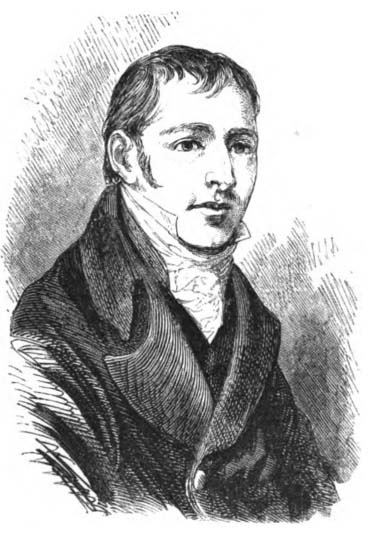
JAMES MONTGOMERY
His
funeral was a public one, and a monument was afterwards
erected to his memory in the town of Sheffield.
'Memoirs of the Life and Writings of James Montgomery,
including Selections from his Correspondence, remains in
prose and verse,
Page 190 -
and Conversations on various subjects; by John Holland
and James Everett; have been published in six volumes
8vo, London, 1854-56.
--- Pp. 184 - 190 |
|
Page 223
MURRAY,
a very common surname in Scotland, the origin of which has
already been explained; see ATHOL, duke of, (vol. i,
p. 164,) and moray, a surname, (page 204 of this
volume). An account of the Murrays of
Tullibardine, the ancestors of the Athol family, is
given under the former head, and those of Bothwell and
Abercairney under the latter.
----------
The
first baronet of the family of Murray of Blackbarony
was Sir Archibald Murray, who was created a baronet
of Nova Scotia, May 15, 1628. He was the son of Sir
John Murray, eldest son of Andrew Murray of
Blackbarony, whose ancestors had been seated at Blackbarony
for five generations prior to 1552. Sir John
was the brother of Sir Gideon Murray,
lord-high-treasurer of Scotland and a lord of session,
father of the first Lord Elibank, (see vol. ii, p.
128) and of Sir William Murray, ancestor of the
Clermont family. Lieutenant-colonel Sir Archibald John
Murray, baronet of Blackbarony, formerly of the Scots
fusilier guards, son of Sir John Murray, baronet of
Blackbarony, by his wife, Anne Digby, of the noble family
of Digby, died, without issue, May 22, 1860. He
was succeeded by his brother, Sir John Digby Murray,
baronet, born in 1798, married, 1st, in 1823, Miss
Susannah Cuthbert, issue one son, John Cuthbert;
2dly, in 1827, Frances, daughter and coheiress of
Peter Patten Bold, Esq., M. p., of Bold hall,
Lancashire; issue, 8 sons and 4 daughters.
----------
The family
of Murray of Clermont, Fifeshire, which possesses a
baronetcy (date 1626), is a branch of the ancient house of
Murray of Blackbarony, whose baronetcy is dated two
yeas later. Sir William Murray, 4th and
youngest son of Sir Andrew Murray of Blackbarony, who
lived in the reign of Mary, queen of Scots, was
knighted by James VI., and having acquired the estate
of Clermont in Fifeshire, it became the designation of his
family. His only son, William Murray of
Clermont, was created a baronet of Nova Scotia, July 1,
1626. Sir James Murray, 5th baronet,
receiver-general of the customs in Scotland, died in
February 1699, without issue, when the title devolved on his
nephew, Sir Robert Murray, 6th baronet, who died in
1771. His eldest son, Sir James Murray, 7th
baronet, a distinguished military officer during the first
American war, was adjutant-general of forces serving on the
continent in 1793. He married in 1794 the countess of
Bath in her own right, and in conse-
Page 224 -
quence assumed the surname and arms of Pulteney.
He subsequently held the office of secretary of war; was
colonel of the 18th foot, and a general in the army.
He died Apr. 26, 1811, leaving no issue, when his
half-brother, Sir John Murray, became 8th baronet.
Sir John was a lieuenant-general in the army, and
colonel of the 56th foot. He died, without issue, in
1827, when the title and estates devolved upon his brother,
the Rev. Sir William Murray, who died May 14, 1842.
The eldest son of the latter, Sir James Pulteney Murray,
10th baronet, died unmarried, Feb. 2, 1843. His
brother, Sir Robert Murray, born Feb. 1, 1815, became
11th baronet; married, in 1839, Susan Catherine Sanders,
widow of Adolphus Cottin Murray, Esq., and 2d
daughter and co-heir of John Murray, Esq., of
Ardeleybury, Herts, lineally descended from Sir William
Murray, father of 1st earl of Tullibardine; with issue,
a son, William Robert, 23d fusiliers, born in 1840,
and a daughter.
----------
The first baronet
of the Stanhope family was Sir William Murray
of Stanhope, and active supporter of the royal cause during
the civil wars, who for his loyalty was created a baronet of
Nova Scotia, after the Restoration, with remainder to his
heirs male whatsoever, 13th February 1664. His
ancestor, John Murray of Falahill, descended from
Archibald de Moravia, mentioned in the Chartulary of
Newbottle in 1280, was known in history as the outlaw
Murray. He died in the early part of the reign of
James V. His exploits are commemorated in
one of the ballads of the 'Minstrelsy of the Scottish
Border.' He married Lady Margaret Hepburn, and
had, with three daughters two sons. His eldest son,
John Murray of Falahill, was ancestor of the Murrays
of Philipbaugh. His second son, William Murray,
married Janet, daughter and heiress of William
Romanno of that ilk, Peebles-shire, and had a son,
William Murray of Romanno, living in December 1531.
The great-grandson of the latter, Sir David Murray,
who was knighted by Charles I., acquired the lands of
Stanhope in the same county, and was the father of Sir
William Murray, the first baronet of Stanhope.
Sir David Murray, the fourth baronet, was implicated in
the rebellion of 1745, and received sentence of death at
York the following year, but was subsequently pardoned on
condition of his leaving the country for life. The
family estates were sold under the authority of the court of
session. Sir David died in exile, without
issue, when the representation of the family devolved on his
uncle, Charles Murray, collector of the customs at
Borrowstownness, who, had the title not been forfeited,
would have been fifth baronet. His son, Sir David
Murray, died without issue at Leghorn, 19th October
1770. The representation of the family then devolved
on John Murray of Broughton, the well-known secretary
of Prince Charles. This personage having
assumed the title after the general act of revisal, became
Sir John Murray of Broughton, baronet. He
married Margaret, daughter of Colonel Robert
Ferguson, brother of William Ferguson of Carloch,
Nithsdale, and had three sons, David, his heir,
Robert, and Thomas, the last a lieutenant-general
in the army. Sir John died 6th December 1777.
His eldest son, Sir David, a naval officer, was
succeeded, on his death in June 1791, by his brother, Sir
Robert, ninth baronet. The son of the latter,
Sir David, became the tenth baronet in 1794, and on his
death, without issue, was succeeded by his brother, Sir
John Murray, eleventh baronet; married, with issue.
----------
The first baronet
of the Ochtertyre family was William Moray of
Ochtertyre, who was created a baronet of Nova Scotia, with
remainder to his heirs male, 7th June 1673. He was
descended from Patrick Moray, the first styled of
Ochtertyre, who died in 1476, a son of Sir David Moray
of Tullibardine. The family continued to spell their
name Moray till 1739, when the present orthography
was adopted by Sir William, 3d baronet. Sir
William Murray, 5th baronet, married Lady Augusta
Mackenzie, youngest daughter of 3d earl of Cromartie;
issue, 3 sons and 2 daughters. He died in 1800.
Of General Sir George Murray, G. C. B., his second
son, a memoir is given at page 232 in
larger type.
The eldest son, Sir Patrick Murray, 6th baronet,
born Feb. 3, 1771, passed advocate at the Scottish bar in
1793, and was appointed a baron of the court of exchequer in
Scotland in 1820. He died June 1, 1837. By his
wife, Lady Mary Hope, youngest daughter of the 2d
earl of Hopetoun, he had 5 sons and 4 daughters.
Capt. John Murray, the 2d son, assumed the name of
Gartshore, on succeeding to the estate of that name in
Dmbartonshire. (See vol. ii, page 284.)
Sir William Keith Murray, the eldest son, 7th
baronet of Ochtertyre, born in 1801, married 1st, Helen
Margaret Oliphant, only child and heiress of Sir
Alexander Keith of Dunnottar, knight marischal of
Scotland; issue, 10 sons and 3 daughters; 2dly, Lady
Adelaide, youngest daughter of 1st marquis of Hastings.
He assumed the name of Keith, on his marriage with
his first wife, and on her death in Oct. 1852, his eldest
son, Patrick, born Jan. 27, 1835, captain grenadier
guards, (retired in June, 1861,) succeeded to the estates of
Dunnottar, Kincardineshire, and Ravelston, Mid Lothian.
Sir William died Oct. 16, 1861, when his eldest son,
Sir Patrick, became 8th baronet.
----------
The Murrays
of Touchadam are supposed to derive from the Morays,
lords of Bothwell. Their progenitor, Sir Willliam
de Moravia, designed of Sanford, joined Robert the
Bruce, but being taken prisoner by the English, was sent
to London in 1306, and remained in captivity there until
exchanged after the battle of Bannockburn. His son and
successor, Sir Andrew de Moravia, called by David
II. "our dear blood relation," obtained from that
monarch a charter of the lands of Kepmad in Stirlingshire,
dated 10th May 1865. This was his first acquisition in
that county. On 28th July 1869 he received another
royal charter of the lands of Tonulcheadam, as
Touchadam was then called, the Tulchmaler, in the same
county. His great-grandson and representative,
William Murray of Touchadam, was scotifer? to
James II., and was appointed constable of Stirling
castle under James III. His eldest son,
David Murray of Touchadam, having no issue, made a
resignation of his whole estate to his nephew, John
Murray of Gawamore, captain of the king's guards and
lord provost of Edinburgh, who succeeded to the same on the
death of his uncle, about 1474. He was a firm and
devoted adherent of James III., and after the battle
of Sauchieburn he was deprived of a considerable portion of
his lands. A great number of the family writs were at
the same time embezzled or lost. His son, William
Murray, the seventh from the founder of the family,
Sir Andrew de Moravia, about 1568, married Agnes,
one of the daughters and coheiresses of James
Cuninghame of Polmaise, Stirlingshire, whereby he
acquired that estate. His son and successor, Sir
John Murray, knight, got a charter under the great seal
of the lands and barony of Polmaise, 8th April 1588.
His grandson, Sir William Murray of Touchadam and
Polmaise, obtained from Charles I. a charter of the
lands of Cowie in 1636. During the civil wars, he
supported the royal cause, and was at the battle of Preston
in 1648, when the army of the royalists under the duke of
Hamilton was defeated. In 1654 he was fined by
Cromwell £1,500.
Page 225 -
William Murray
of Touchadam and Polmaise succeeded his father, William
Murray of Touchadam, Polmaise, and Pitlochie in Fife, in
1814. He died in 1847, when his cousin, John Murray,
born in 1797, the 19th from Sir Andrew de Moravia
succeeded. He died suddenly at London, Apr. 15, 1862,
in his 65th year, and was succeeded by his eldest son,
John, lieutenant-colonel grenadier guards, both in 1831.
----------
The first on
record of the family of Murray of Philiphaugh in
Selkirkshire, Archibald de Moravia, mentioned in the
chartulary of Newbottle in 1280, was also descended, it is
supposed, from the Morays, lords of Bothwell.
In 1296 he swore fealty to Edward I. His son,
Roger de Moravia, obtained in 1321, from James,
Lord Douglas, the superior, a charter of the lands of
Fala, subsequently designated Falahill, for many years the
chief title of the family. The 5th in direct descent
from Roger was John Murray of Falahill, the
celebrated outlaw, who took possession of Ettrick Forest
with 500 men,
"__________ a' in ae liverye
clan.
O' the Lincome grene sae gaye to see;
"He and his ladye in purple clad,
O! gin they lived not royallie!" |
The
king James IV., sent James Boyd to him,
| "The earle of Arran his
brother was he," |
to ask him of whom he
held lands, and desiring him to come and be the king's
"man,"
| "And hald of him yon
fireste free." |
On Boyd
delivering this message to him,
"Thir landis are mine!
the outlaw said;
I ken nae king oin Christentie;
Frae Soudron I this foreste wan.
When the king nor his knightis were not to see." |
And he declared his
intention to keep it
| "Contrair all kingis in
Christentie." |
The king, in
consequence, set forth at the head of a large force,
to punish the outlaw, and force him to submission.
The outlaw summoned to his aid his kinsmen Murray
of Cockpool and Murray of Traquair, who
hastened to Ettrick with all their men. The
barony of Traquair before it came into the
possession of the Stuarts (earls of Traquair)
was the property of the family of Murray,
ancestors of the Murrays of Blackbarony.
The lands of Traquair were forfeited by
Willielmus de Moravia previous to 1464.
They were afterwards, by a charter from the crown
dated 3d February 1478, conveyed to James Stewart,
earl of Buchan, son of the black knight of Lorne,
from whom they descended to the arls of Traquair.
On the approach of the royal force, the outlaw,
"with four in his cumpanie," came and knelt before
the king and said,
"I'll give thee the
keys of my castell,
Wi' the blessing o' my gay ladye,
Gin thou'lt make me sheriffe of this
Foreste,
And a' my offspring after me." |
To this the
king consented, glad to receive his submission
on III.
any terms, and the usual ceremony of feudal
investiture was gone through, by the outlaw
resigning his possessions into the hands of the
king, and receiving them back, to be held of him
as superior.
"He was made
sheriffe of Ettricke Foreste,
Surely while upward grows the tree;
And if he was na traitour to the
king,
Forfaulted he suld never be." |
It is certain
that, by the charter from James IV.,
dated November 30, 1509, John Murray of
Philiphaugh is vested with the dignity of
heritable sheriff of Ettrick Forest, which
included the greater part of what is now
Selkirkshire, an office held by his descendants
till the abolition of the heritable
jurisdictions in 1747. "The tradition of
Ettrick Forest," says Sir Walter Scott,
in his introduction to "The Sang of the Outlaw
Murray,' in the 'Minstrelsy of the Scottish
Border.' "bears that the outlaw was a man of
prodigious strength, possessing a baton or club,
with which he laid lee (i. e. waste) the
country for many miles round, and that he was at
length slain by Buccleuch, or some of his clan,
at a little mount, covered with fir trees,
adjoining to Newark castle, and said to have
been part of the garden. A varying
tradition bears the place of his death to have
been near to the house of the duke of
Buccleuch's gamekeeper, beneath the castle, and
that the fatal arrow was shot by Scott of
Haining from the ruins of a cottage on the
opposite side of the Yarrow. There was
extant, within these twenty years, some verses
of a song on his death. The feud betwixt
the outlaw and the Scotts may serve to
explain the asperity with which the chieftain of
that clan is handled in the ballad." The
laird of Buccleuch had counselled "fire and
sword" against the outlaw; for, says he,
| "He lives by reif
and felonie!" |
But the king
gave him this rebuke:
"And round him
cast a wilie ee, -
Now, haud thy tongue, Sir Walter
Scott,
Nor speak of reif nor felonie: -
For, had every honest man his awin
key,
A right puir clan thy name wad be!" |
The outlaw's
wife, Lady Margaret Hepburn, was the
daughter of the first earl of Bothwell. He
had two sons, James, his heir, and
William, ancestor of the Murrays of
Romanna, afterwards Stanhope, baronets, (see
previous page).
James Murray of Falahill, the elder son, died
about 1529, and his son, Patrick Murray
of Falahill, obtained, under the great seal, a
charter, dated 28th January 1528, of the lands
of Philiphaugh, situated near the royal burgh of
Selkirk, and celebrated as the scene of the
signal defeat of the marquis of Montrose, 15th
September 1645, by General Leslie.
The hollow under the mount adjoining the ruins
of Newark castle, mentioned above as the place
where the outlaw Murray is said to have
been slain, is called by the country people
Slain-man's lee, in which, according to
tradition, the Covenanters, a day or two after
the battle of Philiphaugh, put many of their
prisoners to death. A number of human
bones were, at one period, found there, in
making a drain.
Patrick's great-great-grandson, Sir John
Murray of Philiphaugh, knight, was appointed
by the Scottish Estates one of the judges for
trying those of the counties of Roxburgh and
Selkirk, who had joined the standard of Montrose
in 1646. In 1649 he claimed £12,014, for
the damages he had sustained from Montrose.
He died in 1676.
Page 226 -
His eldest
son, Sir James Murray of Philiphaugh, born in 1655,
was admitted a lord of session in 1689, and appointed
lord-register in 1705. On his death in 1708, he was
succeeded by his eldest son, John Murray of
Philiphaugh, M. P. from 1725 till his decease in 1753.
His gentleman's fourth son, Charles, married a sister
of Robert Scott, Esq. of Danesfield, Bucks, and was
grandfather of Charles Robert Scott Murray, Esq. of
Danesfield, M. P. for that county.
The eldest son, John Murray of Philiphaugh, was
several times M. P. for the county of Selkirk, and once for
the Selkirk burghs, after a severe and expensive contest
with Mr. Dundas. He died in 1800. His
eldest son, John Murray of Philiphaugh, died,
unmarried, in 1830, and was succeeded by his only surviving
brother, James Murray of Philiphaugh, the 17th of the
family, in a direct line; married, with issue.
----------
The Murrays
of Lintrose, Perthshire, are a junior branch of the
Murrays of Ochtertyre, being derived from Mungo
Murray, born 15th July 1662, youngest son of Sir
William Murray of Ochtertyre, baronet, by
Isabel, his wife, the daughter of John Oliphant, Esq.,
of Bachelton. Captain William Murray, a son of
this family, served with the 42d Highlanders, under Wolfe,
in America, and afterwards in the West Indies.
Subsequently, with the rank of major in the same
distinguished regiment, he served under General Howe
against the American revolutionists. On the 15th
September 1776, when the reserve of the British army were in
possession of the heights above New York, Major Murray
was nearly carried off by the enemy, but saved himself by
his strength and presence of mind. Attacked by an
American officer and two soldiers, he kept his assailants at
bay for some time with his fusil; but closing upon him, his
dirk slipped behind him, and being a corpulent man, he was
unable to reach it. Snatching the sword of the
American officer from him, he soon compelled the party to
retreat. He wore the sword as a trophy during the
campaign. He became lieutenant-colonel 27th regiment,
and died the following year.
----------
The Murrays
of Cringletie, Peebles-shire, are descended from a junior
branch of the family of Murray of Blackbarony.
James Wolfe Murray, Esq. of Cringletie, born in 1814,
eldest son of James Wolfe Murray, Lord Cringletie,
a senator of the College of Justice, by Isabella
Katherine, daughter of James Charles Edward Stuart
Strange, Esq., (godson of Prince Charles Edward.)
succeeded his father in 1836; appointed to 42d Royal
highlanders in 1833; married in 1852, Elizabeth Charlotte,
youngest daughter of John Whyte Melville, Esq., and
grand-daughter of 5th duke of Leeds, with issue. His
son, James Wolfe Murray, born in 1853.
----------
Other old
families of the names of Murrays of Broughton,
Wigtownshire; Murray of Murraythwaite, Dumfriesshire;
and Murray of Murrayshall, Perthshire. The
family of Murraythwaite have been settled there since about
1421.
The Murrays of Murrayshall derive in the male
line from the ancient family of Græme
of Balgowan, and in the female, from that of Murray,
Lord Balvaird, (see vol. i, p. 231,) whose eldest son
succeeded as Viscount Stormont, (see STORMONT, Viscounty
of). John Murray, advocate, son of Andrew
Murray of Murrayshall, at one period sheriff of
Aberdeenshire; born in 1809, succeeded in 1847; m. in
1853, Robina, dr. of Thomas Hamilton, Esq.;
educated at Edinburgh university, M. A. 1828. Passed
advocate in 1831.
The Murrays
of Henderland, Peebles-shire, have given two judges to the
court of session, namely, Alexander Murray, Lord
Henderland, who died in 1795, and his second son, Sir
John Archibald Murray, appointed in 1839, when he
assumed the judicial title of Lord Murray. He
had previously been lord-advocate, and recorder of the great
roll, or clerk of the pipe, in the court of exchequer,
Scotland, a sinecure office which had also been held by his
father, and was resigned by Lord Murray, some time
before first appointment as lord-advocate in 1834. He
was M. P. for the Leith district of burghs from 1832 to
1838. He died in 1859.
MURRAY,
SIR ROBERT, one of the founders and
the first president of the Royal Society of London, was the
son of Sir Robert Murray of Craigie, by a daughter of
George Halket of Pitferran. He is supposed to
have been born about the beginning of the seventeenth
century, and received his education partly at St. Andrews
and partly in France. Early in life he entered the
French army, and became so great a favourite with
Cardinal Richelieu that he soon obtained the rank of
colonel. He returned to Scotland about the time that
Charles I. took refuge with the Scots army; and,
while his majesty was with the latter of Newcastle in
December 1646, he formed a plan for the king's escape, which
was only frustrated by Charles' want of resolution.
"The design, "says Burnet, "proceeded so far that the
king put himself in disguise, and went down the back stairs
with Sir Robert Murray; but his majesty, apprehending
it was scarce possible to pass through all the guards
without being discovered, and judging it highly indecent to
be catched in such a condition, changed his resolution with
Charles II., he was appointed justice-clerk, an
office which appears to have remained vacant since the
deprivation of Sir John Hamilton in 1649. A few
days after he was sworn a privy counciller, and in the
succeeding June was nominated a lord of session, but he
never exercised the functions of a judge. At the
Restoration he was reappointed a lord of session, and also
justice-clerk, and made one of the lords auditors of the
exchequer; but these appointments were merely nominal to
secure his support to the government; for, though he was
properly the first who had the style of lord-justice-clerk,
he was ignorant of the law, and it does not appear that he
ever sat on the bench at all. He was high in favour
with the king, Charles II., by whom he was employed
in his chemical processes, and was, indeed, the conductor of
his laboratory. He was succeeded in the office of
justice clerk in
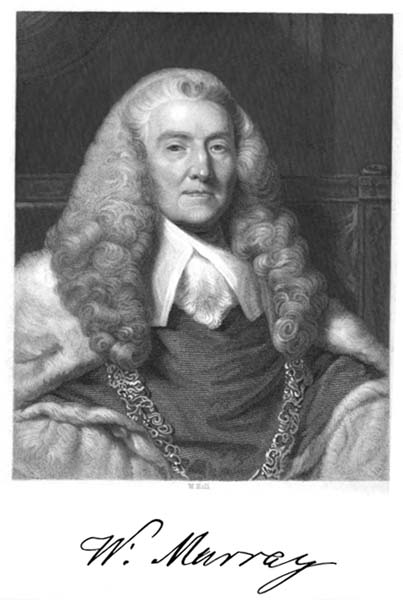
W. MURRAY
Page 227 -
1663 by Sir John Home of Renton; and in 1667 he had a
considerable share in the direction of public affairs in
Scotland, when, not being so obstinately bent on the
establishment of Episcopacy as some of his colleagues, an
unusual degree of moderation marked for a time the
proceedings of the government. Sir Robert's
principal claim to distinction, however, consists in his
having been one of the founders of the Royal Society of
London, and its first president. "While he lived,"
says Bishop Burnet, "he was the life and soul of that
body." He was a member of almost all its obtaining its
charter, in July 1622, and in framing its statutes and
regulations, was indefatigably zealous in promoting its
interests in every respect. Several of is papers,
chiefly on the phenomena of the tides, on the mineral of
Liege, and on other scientific subjects, are inserted
among the early contents of the Philosophical Transactions.
Sir Robert Murray, who had married a sister of
Lord Balcarres, died suddenly, in his pavilion, in the
Garden of Whitehall, July 4, 1673, and was interred at the
king's expense in Westminster Abbey.
MURRAY, THOMAS,
an eminent portrait painter, was born in Scotland in
1666; and at an early age went to London, where he became a
pupil of Riley, state-painter to Charles II., and
successor to Sir Peter Lely He studied nature
carefully, and in his colouring and style imitated his
master, Riley. He painted portraits with great
success and credit; and being employed by the royal family,
as also by many of the nobility, he acquired, in the course
of time, a considerable fortune. The portrait of
Murray, by himself, is honoured with a place in the
gallery of painters at Florence. He died in 1724.
MURRAY, PATRICK, fifth Lord Elibank,
a learned and accomplished nobleman, see ELIBANK,
Lord, VOL. II, P. 130.
MURRAY, WILLIAM,
first earl of Mansfield, a celebrated lawyer and
statesman, the fourth son of David, fifth Viscount
Stormont, was born at Perth, Mar. 2, 1705. He was
removed to London in Mar. 2, 1705. He was removed to
London in 1708, and in 1719 was admitted a king's scholar at
Westminster school. In June 1723 he was entered at
Christ church, Oxford, where he distinguished himself by his
classical attainments. In 1730 he took the degree of
M. A., and afterwards travelled for some time on the
Continent Having become a student at Lincoln's Inn,
he was called to the bar at Michaelmas term 1731. His
abilities were first displayed in appeal cases before the
House of Lords, and he gradually rose to eminence in his
profession. In 1736 he was employed as one of the
counsel for the lord provost and town council of Edinburgh,
to oppose in parliament the Bill of Pains and Penalties,
which afterwards, in a modified form, passed into a law
against them, on account of the Porteous riots. For
his exertions on this occasion, he was presented with the
freedom of the city of Edinburgh in a gold box. In
November 1742 he was appointed solicitor-general in the room
of Sir John Strange, who had resigned. About
the same time he obtained a seat in the House of Commons, as
member for Boroughbridge, in Yorkshire. His eloquence
and legal knowledge soon rendered him very powerful in
debate, and as he was a strenuous defender of the duke of
Newcastle's ministry, he was frequently opposed to Pitt,
afterwards earl of Chatham; these two being considered the
best speakers of their respective parties. In March
1746 he was appointed one of the managers for the
impeachment of Lord Lovat, and the candour and
ability which he displayed on the occasion received the
acknowledgments of the prisoner himself, as well as of the
Lord-chancellor Talbot, who presided on the trial.
In 1754 Mr. Murray succeeded Sir Dudley Ryder
as attorney-general, and on the death of that eminent
lawyer, in November 1756, he became lord-chief-justice of
the king's ben__. Immediately after he was created a
peer of the realm, by the title of Baron Mansfield,
in the county of Nottingham. He was also, at the same
time, sworn a member of the privy council, and, contrary to
general custom, became a member of the cabinet. During
the unsettled state of the ministry in 1757, his lordship
held, for a few months, the office of chancellor of the
exchequer, and during that period he effected a coalition of
parties, which led to the formation of the administration of
his rival Pitt. The same year, on the
retirement of Lord Hardwicke, he declined the offer
of the great seal,
Page 228 -
which he did twice afterwards. During the Rockingham
administration in 1765, Lord Mansfield acted for a
short time with the opposition, especially as regards the
bill for repealing the stamp act. As a judge his
conduct was visited with the severe animadversions of
Junius, and made the subject of much unmerited attack in
both houses of parliament. He was uniformly a friend
to religious toleration, and on various occasions set
himself against vexations prosecutions founded upon
oppressive laws. On the other hand, he incurred much
popular odium by maintaining that, in cases of libel, the
jury were only judges of the fact of publication, and had
nothing to do with the law, as to libel or not. This
was particularly shown in the case of the trial of the
publishers of Junius' letter to the king.
With regard to his thrice refusal of the great seal,
Lord Campbell, in his Lives of the Chief Justices of the
King's Bench, (vol. iii. p. 469,) says, "in 1770, the king
and the duke of Grafton, repeatedly urged Lord Mansfield
to become lord chancellor, but whatever his inclination may
have been when Lord Bute was minister, in the present
ricketty state of affairs he peremptorily refused the
office, and suggested that the great seal should be given to
Charles Yorke, who had been afraid that he would
snatch it from him. By Lord Mansfield's advice
it was that the king sent for Charles Yorke, and
entered into that unfortunate negotiation with him which
terminated so fatally - occasioning the comparison between
this unhappy man, destroyed by gaining his wish, and Semele
perishing by the lightning she had long for. For some
months the chief justice presided on the woolsack as Speaker
of the House of Lords, and exercised almost all the
functions belonging of the office of Lord Chancellor."
In October, 1776, having been
previously created a knight of the Thistle, Lord
Mansfield was advanced to the dignity of an earl of the
United Kingdom by the title of earl of Mansfield, with
remainder to the Stormont family, as he had no issue
of his own. During the famous London riots of June
1780, his house in Bloomsbury Square was attacked and set
fire to by the mob, in consequence of his having voted in
favour of the bill for the relief of the Roman Catholics,
and all his furniture, pictures, books, manuscripts, and
other valuables were entirely consumed. His lordship
himself, it is said, made his escape in disguise, before the
flames burst out. He declined the offer of
compensation from government for the destruction of his
property. The infirmities o_ age compelled him, June
3, 1788, to resign the office of chief-justice, which he had
filled with the distinguished reputation for thirty-two
years. The latter part of his life was spent in
retirement, principally at his seat at Caen Wood, near
Hampstead. He died Mar. 20, 1793, and was buried in
Westminster Abbey. The earldom, which was granted
again by a new patent in July 1792, descended to his nephew,
Viscount Stormont. (See STORMONT,
Viscount of.) A life of Lord Mansfield, by
Holliday, was published in 1797, and another, by
Thomas Roscoe, appeared in 'The Lives of British
Lawyers,' in Lardner's Cyclopædia.
MURRAY, LORD
GEORGE, lieutenant-general of the
rebel Highland army in 1745-6, was the fourth son of the
first duke. Born in 1705, he took a share in the
insurrection of 1715, though then but ten years old, and he
was one of the few persons who joined the Spanish forces
which were defeated in Glenshiel in1719. He afterwards
served several years as an officer in the king of Sardinia's
army; but having obtained a pardon he returned from exile,
and was presented by George I. by his brother the
duke of Athol. He joined Prince Charles at
Perth in September, 1745, and was immediately appointed
lieutenant-general of the insurgent forces. The battle
of Preston, where he commanded the left wing of the prince's
army, was, in a great measure, gained through his personal
intrepidity. "Lord George," says the chevalier
Johnstone, in his 'Memoirs of the Rebellion,' "at the
head of the first line, did not give the enemy time to
recover from their panic. He advanced with such
rapidity that General Cope had hardly time to form
his troops in order of battle when the Highlanders rushed
upon them, sword in hand, and the English cavalry was
instantly thrown into confusion."
On the advance of the rebel army into England, Lord
George had the command of the blockade of Carlisle,
which soon surrendered. Owing to the
Page 229 -
intrigues of Murray of Broughton, secretary to the
prince, whose "unbounded ambition," we are told, "from the
beginning aimed at nothing less than the whole direction and
management of every thing," Lord George was induced,
at this time, to resign his command as one of the
lieutenant-generals of the army, acquainting the prince that
thenceforward he would serve as a volunteer. At the
siege of Carlisle, the duke of Perth had acted as principal
commander, and Lord George, it was thought, was not
willing to serve under him for the rest of the campaign.
The duke, however, subsequently declined the principal
command, when Lord George, who had resumed his place,
became general of the army under the prince.
He was the first to recommend the retrograde movement
from Derby, of which he offered to undertake the conduct.
In that memorable retreat he commanded the rear-guard,
and contrived to keep the English forces effectually in
check. Being delayed by the breaking down of some
baggage waggons, the enemy came upon him at Clifton in
Cumberland. His force consisted of about a thousand
men, and he applied to the prince, who was then at Penrith
with the main body of the army, for a reinforcement.
Instead of receiving it, however, orders were sent to him to
pursue his retreat; but, after requesting the messenger to
keep secret the orders he had brought, he determined to
attack the enemy with what force he had. He,
therefore, drew up his troops in order of battle, and the
English, under the duke of Cumberland, came up just as the
sun was setting. After making his hasty arrangements,
which were not completed till it was quite dark, he made a
powerful charge upon the English, lighted by the moon which
broke at intervals through the dark clouds. The
English cavalry were forced back with a severe loss, while
the Highlanders lost but twelve men.
At the battle of Falkirk, Lord George had the
command of the right wing, and took his place at the head of
the Macdonalds of Keppoch, with his drawn sword in his hand,
and his target on his arm. When the English dragoons
came within ten or twelve paces of him, he gave orders to
fire. "The cavalry closing their ranks, which were
opened by this discharge," says Johnstone, "put spurs
to their horses, and rushed upon the Highlanders at a hard
trot, breaking their ranks, and throwing down everything
before them. A most extraordinary combat followed.
The Highlanders, stretched upon the ground, thrust their
dirks into the bellies of the horses; some seized the riders
by their clothes, dragged them down, and stabbed them with
their dirks; several of them again used pistols, but a few
of them had sufficient space to handle their swords."
This victory, like that at Preston, was, in a great measure,
achieved by the personal bravery of Lord George Murray,
though the prince himself commanded.
On arriving at Inverness, Lord George received
information of various cruelties practised by the English
troops on the people of Athol. He "set off instantly,"
says Johnstone, "with the clan of Athol, to take
vengeance for these outrages, and be conducted his march so
well passing through byeways across the mountains, that the
enemy had no information of his approach. Having
planned his march so as to arrive at Athol in the beginning
of the night, the detachment separated, dividing itself into
small parties, every gentleman taking the shortest road to
his own house," and in this way all English were surprised
at their posts. Many were put to the sword, and about
300 were made prisoners. Sir Andrew Agnew, who
held the castle of Blair, marched out with a
detachment to ascertain who they were that had attacked his
posts, but owing to the precautions taken by Lord George,
he returned to the castle, without venturing on an attack.
Lord George then invested the castle, which he
blockaded, and the garrison, reduced to great distress from
want of provisions, were expected soon to surrender, when
his lordship received an order from the prince to return to
Inverness, in consequence of the advance of the duke of
Cumberland.
It was Lord George Murray who proposed the night
march to Nairn, the evening before the battle of Culloden,
with the view of surprising the army of the duke of
Cumberland. He led the van for that attack, but
finding that the rear of the Highlanders did not come up in
time, he at once advised a retreat. At the battle of
Culloden Lord George commanded the right wing of the
prince's army. The English artillery was rapidly
Page 230 -
thinning his ranks when he gave orders to charge. The
first line of the English army reeled and gave way before
them. But their opponents were so numerous that before
the Highlanders could reach the second line of the English
they were entirely destroyed. On this occasion Lord
George displayed all his former heroism. While
advancing towards the second line, in attempting to dismount
from his horse, which had become unmanageable, he was
thrown; but, recovering himself, he ran to the rear and
brought up two or three regiments from the second line of
the Highlanders, to support the first; but although they
gave their fire, nothing could be done, - all was lost.
After their defeat, Lord George and the other
chiefs who remained with the army retired to Ruthven, where
they assembled a force of about 3,000 men, but two or three
days after the battle they received orders from the prince
to disperse. His lordship had written to Charles,
pointing out the principal causes which had led to the
loss of the battle, and requesting him to accept of the
resignation of his commission, but when he found that it was
the intention of the prince to depart for France, he sent a
message to him earnestly dissuading him from such a course,
and advising him to remain in Scotland and try another
campaign. He maintained that the Highlanders "could
have made a summer's campaign without the risk of any
misfortune;" and "though they had neither money nor
magazines, they would not have starved in that season of the
year so long as there were sheep and cattle."
On the prince's escape, Lord George Withdrew to
the Continent, and having spent some years in France and
Italy, died in Holland on the 8th July 1760. His
character is thus sketched by Johnstone: - "Lord
George Murray, who had the charge of all the details of
our army, and who had the sole direction of it, possessed a
natural genius for military operations; and was a man of
surprising talents, which had they been cultivated by the
study of military tactics, would unquestionably have
rendered him one of the greatest generals of his age.
He wa tall and robust, and brave in the highest degree;
conducting the Highlanders in the most heroic manner, and
always the first to rush, sword in hand, into the midst of
the enemy. He used to say, when we advanced to the
charge, 'I do not ask you, my lands, to go before, but
merely to follow me.' He slept little, was continually
occupied with all manner of details; and was, altogether,
most indefatigable, combining and directing alone all our
operations: - in a word, he was the only person capable of
conducting our army. He was vigilant, active, and
diligent; his plans were always judiciously formed, and he
carried them promptly and vigorously into execution.
However, with an infinity of good qualities, he was not
without his defects: - proud, haughty, blunt, and imperious,
he wished to have the exclusive ordering of everything, and,
feeling his superiority, he would listen to no advice.
Still, it must be owned, that he had no coadjutor capable of
advising him, and his having so completely the confidence of
his soldiers enabled him to perform wonders."
MURRAY,
ALEXANDER, D. D., a
celebrated self--taught philologist, was born at
Dunkitterick, in the parish of Minnigaff, stewardtry of
Kirkcudbright, Oct. 22, 1775. His father was the
humble Galloway shepherd, an occupation followed by his
ancestors for several generations, and for which he himself
was originally designed. He was taught to read by his
father, who was in his seventieth year at the time of his
birth. The method which the old man adopted was to
draw the figures of the letters on an old wool card with the
ends of the burnt roots of the heather that grew on the
hills. After thus learning the letters by means of the
burnt sticks, he was advanced to the catechism, which was
the child's primer in those days. Then he somehow
obtained a New Testament, and afterwards a whole Bible, by
going to a place where an old tattered copy of it lay, which
he carried off bit by bit. In the wild solitary glen
where his father lived, he made himself master of the whole
contents of the sacred volume, and also devoured every
printed scrap of paper on which he could lay his hands, and
so strong was his memory that even when he was but a boy he
could repeat the names of the patriarchs and scripture
characters from Adam to our Saviour without
omitting one. When about seven years old, he was
employed on the hills in herding sheep. The poverty of
the family, and the
Page 231 -
remote situation of their hut, prevented his being sent
early to school, and in fact he would never have obtained
any regular instruction at all, had not a brother of his
mother, named William Cochrane, offered, in May 1784,
to be at the expense of sending him to school, and boarding
him for a short time in New Galloway. Bad health,
however, obliged him to return home before he had been six
months at school, and for more than four years after this he
had no opportunity of resuming his attendance. In the
meaintime he was employed as usual as a shepherd boy, and
for about three years the Bible, and what "ballads and penny
stories" he could pick up, formed his only reading.
In the end of 1787 he engaged to teach throughout the
winter the children of two neighbouring farmers, and as a
remuneration, he received sixteen shillings, part of which
he immediately laid out in the purchase of books. Soon
after he began to give irregular attendance for a short time
at the school of Minnigaff, chiefly for the purpose of
improving his arithmetic, with the view of becoming a
merchant's clerk. In 1790, having obtained a cheap
copy of Ainsworth's Dictionary, he began the study of Latin,
and in May of that year commenced to learn French. In
the summer of 1791 he again attended school for about three
months, and read with avidity whatever books he could
anywhere borrow, whether in English, French, Latin, Greek,
or Hebrew, for so great was his application, that he had
made himself master of all these languages within the space
of only about eighteen months, and that chiefly by his own
unaided exertions.
In the winter of 1792-3 he again engaged in teaching,
when he received, as he informs us, for his labours, about
thirty shillings. During the same winter he went in
the evenings to a school at Bridgend of Cree, where he
remained for about three months and a half. The whole
period of his school attendance, scattered over a space of
eight years, did not exceed thirteen months; but every spare
hour was given to study, and as he himself tells us, French,
Latin, Greek, and Hebrew occupied all his leisure time.
In 1791 he had made himself acquainted with the Abysainian
alphabet, from an inaccurate copy which he transcribed from
an odd volume of the Unifersal History. The Arabic
letters he had learned previously from Robertson's Hebrew
Grammar. He had purchased the same year, for a trifle,
a manuscript volume of the Lectures of Arnold Drackenburg,
a German professor, on the lives and writings of the Roman
authors, from Livius Andronicus to Quintilian, which he
afterwards translated, and in 1794 offered his version
to the book-sellers at Dumfries, with a number of poems
which he had composed, chiefly in the Scottish dialect, but
neither of the two booksellers in that town would undertake
the publication. During this visit to Dumfries he was
introduced to Burns, the poet, who treated him with
great kindness, and gave him some useful hints as to his
poetry.
The fame of his extraordinary acquirements having
extended to Edinburgh, in November 1794 he was invited to
that city, when he underwent an examination before
Principal Baird and two of the other city clergymen.
The extent and accuracy of his classical attainments made
such an impression on these gentlemen, that they exerted
their influence to procure for him a free attendance at the
classes in the university, and contributed to his means of
subsistence during the first two years of his academic
career. At the end of that period he obtained a
bursary, or exhibition, from the city, and soon after was
able to support himself by private teaching. He
continued to devote himself with all his wonted enthusiasm
to the study of languages, and after having attained to a
knowledge of all those spoken in Europe, he commenced his
investigations into the Oriental tongues, and of the six or
seven dialects of the Abyssinian or Ethiopic language, in
particular, he made himself completely master. The
latter circumstance induced Mr. Constable, the
publisher, to employ him in 1802 to superintend a new
edition of 'Bruce's Travels to discover the Source of the
Nile,' which appeared in seven volumes 8vo, in 1805, with a
Life of the author prefixed, and a mass of illustrative
notes. The Life of Bruce he afterwards enlarged and
published separately. He had previously contributed
several miscellaneous pieces to the Scots Magazine, of which
he was at one time editor.
Having passed through the usual college course, to
qualify him for the ministry in the Church of
Page 232 -
Scotland, he was appointed in 1806 assistant and successor
to the Rev. Mr. Muirhead, minister of Urr, in the
stewartry of Kirkcudbright, and on the death of the latter
in 1808, he succeeded to the full incumbency of the parish.
In 1812 he became a candidate for the vacant professorship
of Oriental Languages in the university of Edinburgh, and
among the numerous testimonials of his qualifications which
were published on the occasion, was one from Mr.
Salt, formerly envoy to Abyssinia, whose admiration of
the deep erudition and extensive research displayed in his
edition of Bruce's Travels, caused him, on his return to
England in February 1811, to recommend him to the marquis of
Wellesley, as the only person in the British dominions”
adequate to translate an Ethiopic letter which he had
brought from the governor of Tigre to George III.
In remembrance of Mr. Murray's services in
translating this letter, a pension of £80 a -year was after
his death grant ed by his majesty to his widow. He was
elected professor of Oriental Languages on July 8, by a
majority of two votes, and a few days thereafter the senatus
of the university conferred on him the degree of D.D.
He was not destined, however, to occupy long a chair which
he was so admirably qualified to fill. On October 31
he entered upon the discharge of his professional duties in
a weak state of health, and continued with the utmost ardour
to teach his classes during the winter. At that
commencement of the session he published his 'Outlines of
Oriental Philology,' an elementary work, designed for the
use of his students. In the beginning of February a
new impression of his edition of Bruce's Travels also made
its appearance. Soon after, his illness assumed such
an alarming aspect as to prevent his lecturing, though he
continued his literary labours to the last, having been the
very day before his death engaged nearly twelve hours in
arranging his papers, &c. He died on the morning of
Apr. 15, 1813, in his 37th year. In his latter years
he had written a work of great learning, entitled 'History
of European Languages,' which was published after his death
in 2 vols. 8vo, under the auspices of Sir Henry Moncreiff
and the Rev. Dr. Scot of Corstorphine. By his
wife, whom he married while residing at Urr, Dr. Murray
had a son and daughter, the latter of whom died in 1821.
Subjoined is his portrait, from a painting by Geddes,
engraved by Burnet:
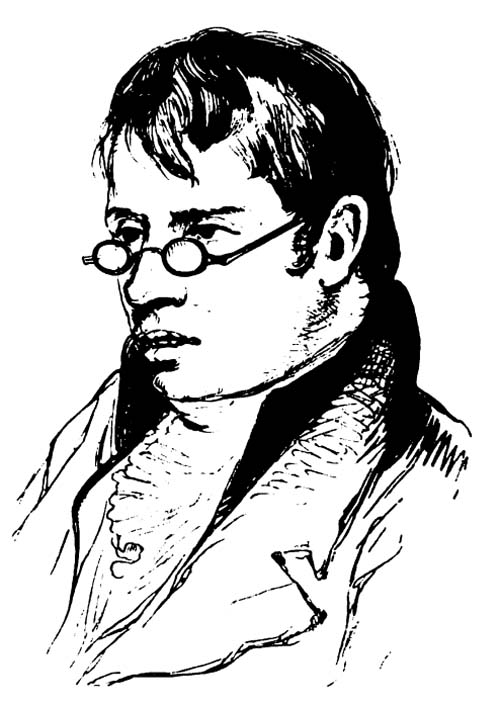
ALEXANDER MURRAY
MURRAY, Sir George, an
able military officer and diplomatist, the second son of
Sir William Murray, the fifth baronet of Ochtertyre, was
born at the family seat in Perthshire, Feb. 6, 1772.
He was educated at the high school and university of
Edinburgh, and on 12th March 1789, was gazetted an ensign in
the 71st foot. Soon after, he removed to the 34th
regiment, and in June 1790 to the 3d Guards. In 1793
he was in the army under the duke of York which was employed
against the French in Flanders, and in January 1794 he was
promoted to a lieutenancy, with the rank of captain.
In April of that year he returned to England, but having
rejoined the army in Flanders during the summer, he was
present in the retreat through Holland and Germany. In
1795 he was appointed aide-de-camp to Major-general Sir
Alexander Campbell, on the staff of Lord Moira's
army in the expedition intended for Quiberon. In the
autumn of the same year, he proceeded to the West Indies
under Sir Ralph Abercromby, but in consequence of
ill-health he soon returned, and he served on the staff in
Eng-
Page 233 -
land and Ireland during the years 1797 and 1798. In
August 1799 he was appointed a captain in the guards, with
the rank of lieutenant-colonel. He participated in all
the dangers and disasters of the expedition to Holland that
year, and was wounded at the Helder. He was soon,
however, able to proceed with his regiment to Cork, whence
he embarked with it to Gibraltar, as part of the force under
the orders of Sir Ralph Abercromby. Having been
placed in the quarter-master-general's department, he went
to Egypt for the purpose of making arrangements preparatory
to the celebrated expedition against the French in that
country, and while there he displayed so much gallantry and
skill that the Turkish government conferred upon him the
order of the crescent, second class.
He was present in every one of the engagements in
Egypt, at Marmorice and Aboukir, at Rosetta and Rahanieh, at
Cairo and Alexandria, and had the good fortune to escape
without a wound. In 1802 he went to Egypt to the West
Indies, and remained there a year as adjutant-general to the
British forces in those colonies. On his return to
England, he filled a situation at the Horse Guards. In
1804 he was appointed deputy quarter-master-general in
Ireland. In 1806 he was engaged in active service in
the expedition to Stralsund, but that design was rendered
abortive by the successes of the French in Poland.
About two years thereafter, Colonel Murray was
intrusted with a diplomatic mission to Sweden, and being
there at the time that the expedition under Sir John
Moore went to that country, he received from that
distinguished commander the appointment of
quarter-master-general. Very soon afterwards, the
troops under Sir John Moore joined the army in
Portugal, and Colonel Murray, who went along with
them, served all through the peninsular war. On new
year's day 1812, he became a major-general, and on 9th
August 1813 he was appointed colonel of the 7th Battalion of
the 60th regiment. In 1817 he was removed to the 72d
foot, and on Sept. 11, 1813, was nominated a knight of the
Bath, before the enlargement of that order.
After serving for a short time as adjutant-general in
Ireland, Sir George was appointed governor of the
Canadas. He had not been long there when the secretary
of state announced to him that the Emperor Napoleon
had landed at Cannes from Elba. He had the choice of
either remaining in Canada, or returning to Europe, to
engage in active service. He preferred the latter, but
the delay occasioned by the embarkation of a large body of
troops, and the slow progress made in sailing with a fleet
of transports, prevented his arriving in time, and he did
not join the duke of Wellington's army till it had nearly
reached Paris, after the battle of Waterloo.
During the stay of our army of occupation in France,
Sir George remained with them, with the local rank of a
lieutenant-general. While in Paris he received seven
orders of knighthood, besides those conferred by his own
sovereign, so highly were his character and services held in
estimation by continental monarchs. He became a knight
Grand Cross of Hanover; knight Grand Cross of Leopold,
St. Alexander Newski, and the Red Eagle; a
commander of the Tower and Sword, Maximilian Joseph, and St.
Henry.
On the return of the army of occupation to England in
1817, Sir George Murray was appointed governor of
Edinburgh castle, but he held that office only for a year,
as on 18th August 1819, he was nominated governor of the
Royal Military College at Woolwich. On 14th June 1820,
the university of Oxford conferred on him the degree of D.
C. L., and in January 1824 he was chosen a fellow of the
Royal Society. In September 1823 he had been appointed
to the command of the 42d foot, and on 6th March following
he became lieutenant-general of the ordnance. The same
year (1824) he was chosen M. P. for the county of Perth.
at this time he filled the office of commander of the forces
in Ireland.
At the general election of 1826, he was again returned
for Perthshire. In January 1828, when the duke of
Wellington became prime minister, Sir George Murray
was appointed secretary of state for the colonies; on which
occasion he resigned the command of the army in Ireland, and
was sworn a member of the privy council. From that
period he distinguished himself as a ready and fluent
speaker in the House of Commons. He supported the
Roman Catholic emancipation.
Page 234 -
bill of 1829, and after the whig government came into power
in November 1830, he was one of the principal members of the
opposition. In that year, and again in 1831, he was
re-elected for Perthshire, but on the dissolution of
parliament in 1832, after the passing of the Reform Bill, he
was defeated by the earl of Ormelie, afterwards marquis of
Breadalbane. In 1834 his lordship became a member of
the House of Lords, and Sir George Murray was again
elected M. P. for Perthshire.
In Sir Robert Peel's administration of 1834-5,
Sir George held the office of master-general of the
ordnance. At the general election which ensued he was
opposed by Mr. Fox Maule, afterwards Lord Panmure,
who defeated him by a majority of 82. At the general
election of 1837, Sir George stood for Westminster,
but was unsuccessful. Two years subsequently he became
a candidate for Manchester, and was again defeated.
On the death of Lord Lynedoch in 1843, he
succeeded him as colonel of the 1st or Royal regiment of
foot. He attained the rank of lieutenant-general May
27, 1825, and that of general, Nov. 23, 1841. He was
editor of 'The Duke of Marlborough's Letters and Despatches,'
from 1702 to 1712, which were published in 1845. He
will be remembered as a successful soldier, and able
minister, and a skilful and fluent debater. He died in
London 26th July 1846, aged 74, and was buried at Kensal
Green. At the time of his death he was governor of
Fort George and president of the Royal Geographical Society.
He had married in 1826, in the 54th year of his age, Lady
Louisa Erskine, sister of the marquis of Anglesey and
widow of Lieutenant-general Sir James Erskine,
baronet. Lady Louisa was then 48. She
died 23d January 1842. They had one daughter, who
married H. G. Boyce, Esq., of the 2d life guards, and
died in 1849.
--- Pp. 223 - 234 |
|
|
<
CLICK HERE to
RETURN to TABLE of CONTENTS >
.
|

