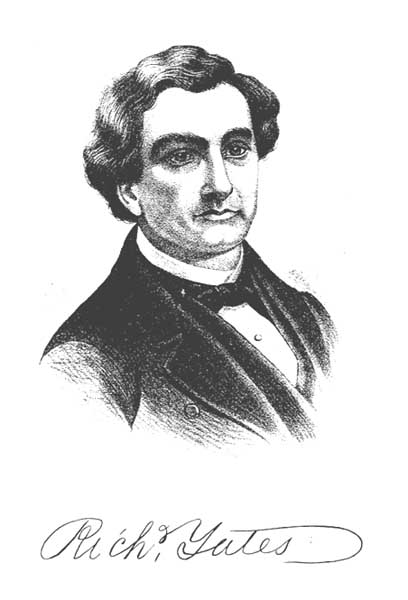
Richd Yates |
RICHARD
YATES, the "War Governor," 1861-4, was born
Jan. 18, 1818, on the banks of the Ohio River, at Warsaw, Gallatin
Co., Ky. His father moved in 1831 to Illinois, and after
stopping for a time in Springfield, settled at Island Grove,
Sangamon County. Here, after attending school, Richard
joined the family. Subsequently he entered Illinois College at
Jacksonville, where, in 1837, he graduated with first honors.
He chose for his profession the law, the Hon. J. J. Hardin
being his instructor. After admission to the Bar he soon rose
to distinction as an advocate.
Gifted with a fluent and ready oratory, he soon
appeared in the political hustings, and, being a passionate admirer
of the great Whig leader of the West, Henry Clay he joined
his political fortunes to the part of his idol. In 1840
he engaged with great ardor in the exciting "hard cider" campaign
for Harrison. Two years later he was elected to the
Legislature from Morgan County, a Democratic stronghold. He
served three or four terms in the Legislature, and such was the
fascination of his oratory that by 1850 his large Congressional
District, extending from Morgan and Sangamon Counties north to
include LaSalle, unanimously tendered him the Whig nomination for
Congress. His democratic opponent was Maj. Thomas L. Harris,
a very popular man who had won distinction at the battle of Cerro
Gordo, in the Mexican War, and who had beaten Hon. Stephen T.
Logan for the same position, two years before, by a large
majority. Yates was elected. Two years later he
was re-elected, over John Calhoun.
It was during Yates second term
in Congress that the great question of the repeal of the Missouri
Compromise was agitated, and the bars laid down for re-opening the
dreaded anti-slavery question. He took strong grounds against
the repeal, and thus became identified with the rising Republican
party. Consequently he fell into the minority in his district,
which was pro-slavery. Even then, in a third contest, he fell
behind Major Harris only 200 votes, after the district had
two years before given Pierce 2,000 majority for President.
The Republican State Convention of 1860 met at Decatur
May 9, and nominated for the office of Governor Mr. Yates, in
preference to Hon. Norman B. Judd, of Chicago, and Leonard
Swett, of Bloomington, two of the ablest men of the State, who
were also candidates before the Convention. Francis A.
Hoffman, of DuPage County, was nominated for Lieutenant
Governor. This was the year when Mr. Lincoln was a
candidate for President, a period remembered as characterized by the
great whirlpool which precipitated the bloody War of the Rebellion.
The Douglas Democrats nominated J. C. Allen of
Crawford County, for Governor, and Lewis W. Ross, of Fulton
County, for Lieutenant Governor. The Breckenridge
Democrats and the Bell-Everett party had also full
tickets in the field. After a most fearful campaign, the
result of the election gave Mr. Yates 172,196 votes, and
Mr. Allen 159, 253. Mr. Yates received over a
thousand more votes than did Mr. Lincoln himself.
Gov. Yates occupied the chair of State during the
most critical period of our country's history. In the fate of
the nation was involved that of each State. The life struggle
of the former derived its sustenance from the loyalty of the latter;
and Gov. Yates seemed to realize the situation, and proved
himself both loyal and wise in upholding the Government. He
had a deep hold upon the affections of the people, won by his moving
eloquence and genial manners. erect and symmetrical in person,
of prepossessing appearance, with a winning address and a magnetic
power, few men possessed more of the elements of popularity.
His oratory was scholarly and captivating, his hearers hardly
knowing why they were transported. He was social and
convivial. In the latter respect he was ultimately carried too
far.
The very creditable military efforts of this State
during the War of the Rebellion, in putting into the field the
enormous number of about 200,000 soldiers, were ever promptly and
ably seconded by his excellency; and the was ambitious to deserve
the title of "The soldier's friend." Immediately after the
battle of Shiloh he repaired to the field of Carnage to look after
the wounded and his appeals for aid were promptly responded to by
the people. His proclamations calling for volunteers were
impassionate appeals, urging upon the people the duties and
requirements of patriotism; and his special message in 1863 to the
Democratic Legislature of this State pleading for material aid for
the sick and wounded soldiers of Illinois regiments, breathes a deep
ferfor of noble sentiment and feeling rarely equaled in
beauty or felicity of expression. Generally his messages on
political and civil affairs were able and comprehensive.
During his administration, however, there were no civil events of an
engrossing character, although two years of his time were replete
with partisan quarrels of great bitterness. Military arrests,
Knights of the Golden Circle, riot in Fulton County, attempted
suppression of the Chicago Times and the usurping
State Constitutional Convention of 1862, were the chief local topics
that were exciting during the Governor's term. This Convention
assembled Jan. 7, and at once took the high position that the law
calling it was no longer binding, and that it had supreme power;
that it represented a virtual assemblage of the whole people of the
State, and was sovereign in the exercise of all power necessary to
effect a peaceable revolution of the State Government and to the
re-establishment of one for the "happiness, prosperity and freedom
of the citizens," limited only by the Federal Constitution.
Notwithstanding the law calling the Convention required its members
to take an oath to support the Constitution of the State as well as
that of the general Government, they utterly refused to take such
oath. They also assumed legislative powers and passed several
important "laws!" Interfering with the (then) present
executive duties, Gov. Yates was provoked to tell them
plainly that "He did not acknowledge the right of the Convention to
instruct him in the performance of his duty."
In 1863 the Governor astonished the Democrats by
"proroguing" their Legislature. This body, after a recess, met
June 2, that year, and soon began to waste time upon various
partisan resolutions; and, while the two houses were disagreeing
upon the question of adjourning sine die, the Governor,
having the authority in such cases, surprises them all by adjourning
them "to the Saturday next preceding the first Monday in January,
1865!" This led to great excitement and confusion, and to a
reference of the Governor's act to the Supreme Court, who decided in
his favor. Then it was the Court's turn to receive abuse for
weeks and months afterward.
During the autumn of 1864 a conspiracy was detected at
Chicago which had for its object the liberation of the prisoners of
war at Camp Douglas, the burning of the city and the inauguration of
rebellion in the North. Gen. Sweet, who had charge of
the camp at the time, first had his suspicious of danger aroused by
a number of enigmatically worded letters which passed through the
Camp postoffice. A detective afterward discovered that the
rebel Gen. Marmaduke was in the city, under an assumed
name, and he, with other rebel officers - Grenfell, Morgan,
Cantrell, Buckner Morris, and Charles Walsh - was arrested,
most of whom were convicted by a court-martial at Cincinnati and
sentenced to imprisonment, - Grenfell to be hung. The
sentence of the latter was afterward commuted to imprisonment for
life, and all the others, after nine months' imprisonment, were
pardoned.
In March, 1873, Gov. Yates was appointed a
Government Director of the Union Pacific Railroad, in which office
he continued until his deceased, at St. Louis, Mo., on the 27th of
November following.
Source:
Source: Portrait & Biographical Album
of DeWitt and Piatt Counties, Illinois,
Publ.
Chicago: Chapman Bros.,
1891~ Page
159 |